Regression
Overview
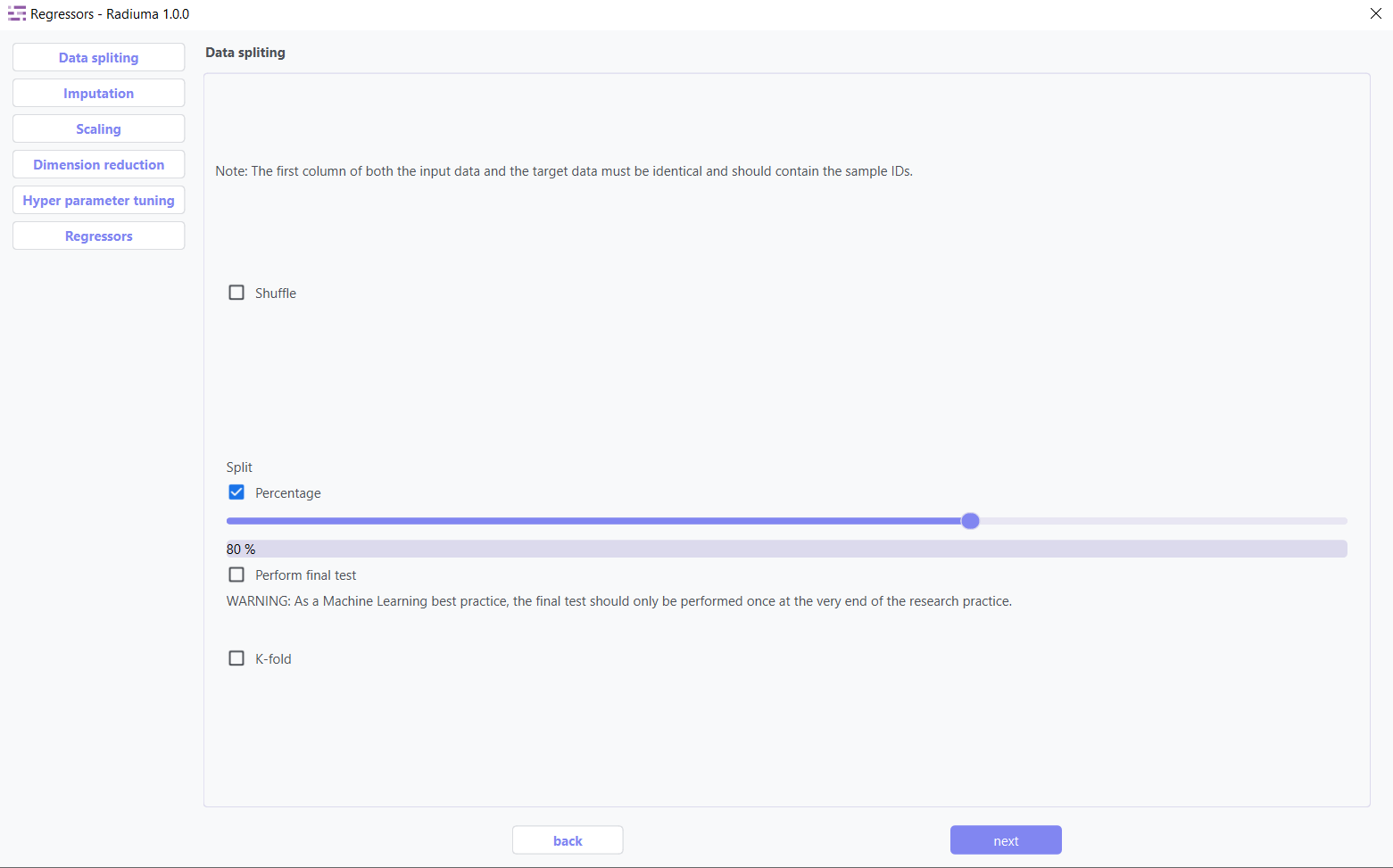
The Regression module delivers a streamlined, step-by-step workflow within the application for building predictive models with continuous target variables. Starting with structured data import, the interface automatically validates your feature and target tables to ensure proper formatting before analysis. Through an organized sequence of configurable panels, you can systematically apply data splitting strategies, address missing values using sophisticated imputation techniques, normalize features with multiple scaling options, and optimize your dataset through dimension reduction methods. The module then presents a comprehensive selection of regression algorithms with customizable parameters, enabling simultaneous training and comparison of multiple models. The system culminates with detailed performance metrics and residual analysis, providing you with the tools to identify the most accurate predictive model for your clinical research, outcome prediction, or biomarker discovery projects—all within a unified, user-friendly environment designed for both statistical experts and medical researchers.
The Regression tool provides a complete predictive modeling pipeline for continuous target variables with:
5 regression algorithms
Automated data preprocessing
Hyperparameter optimization
Comprehensive model evaluation
Data Import
Before splitting or processing your data, ensure it is properly structured.
Note
Both feature and target tables must follow these requirements:
Identical Sample IDs in the first column of both tables.
Sample IDs must match exactly. e.g., Patient_001 in the feature table = Patient_001 in the target table.
Target column must be categorical for classification tasks (e.g., High / Low or 0 / 1).
Data Import Steps:
Import Feature Table
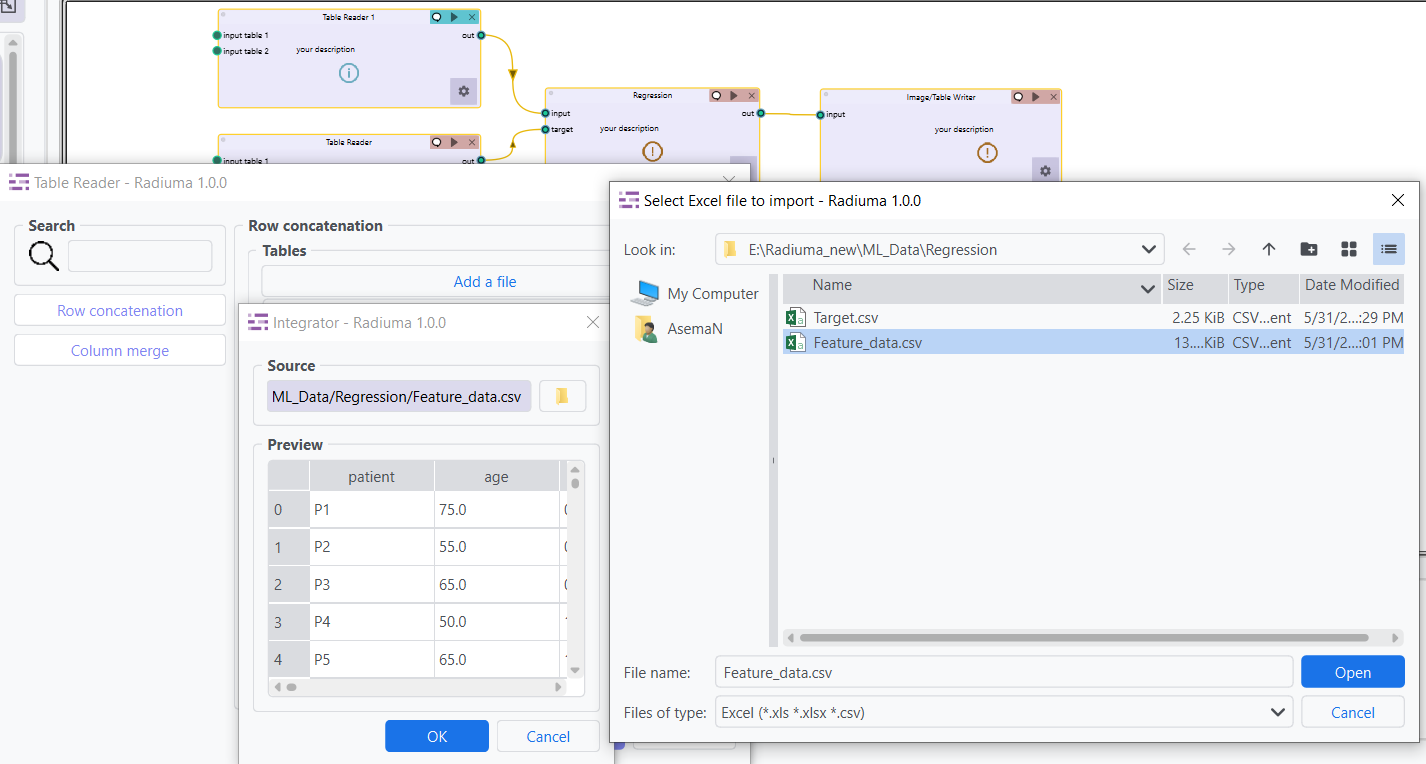
Select your main data table containing all features/predictors. Preview the table to verify structure.
Import Target Table
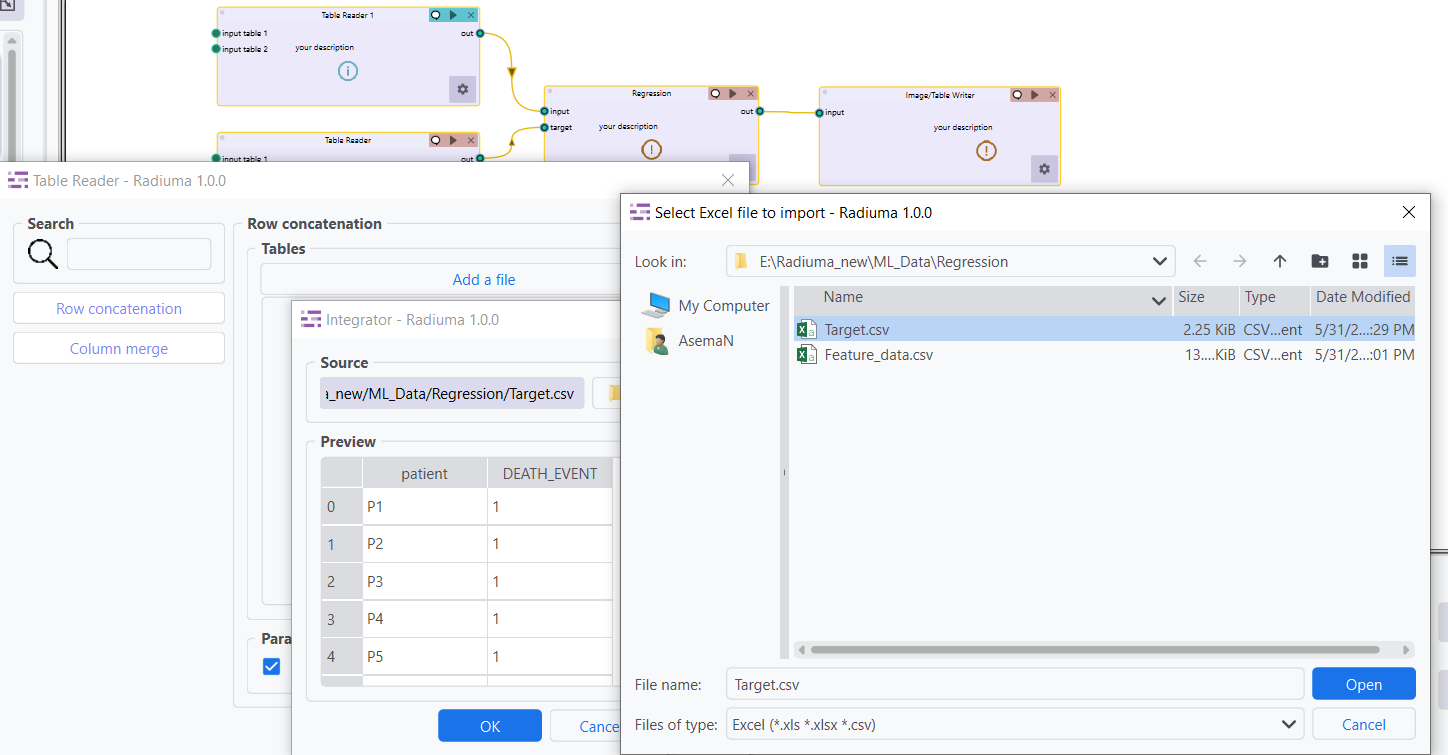
Select your target table containing only Sample IDs and Class Labels. Preview the table to verify structure.
Data Splitting
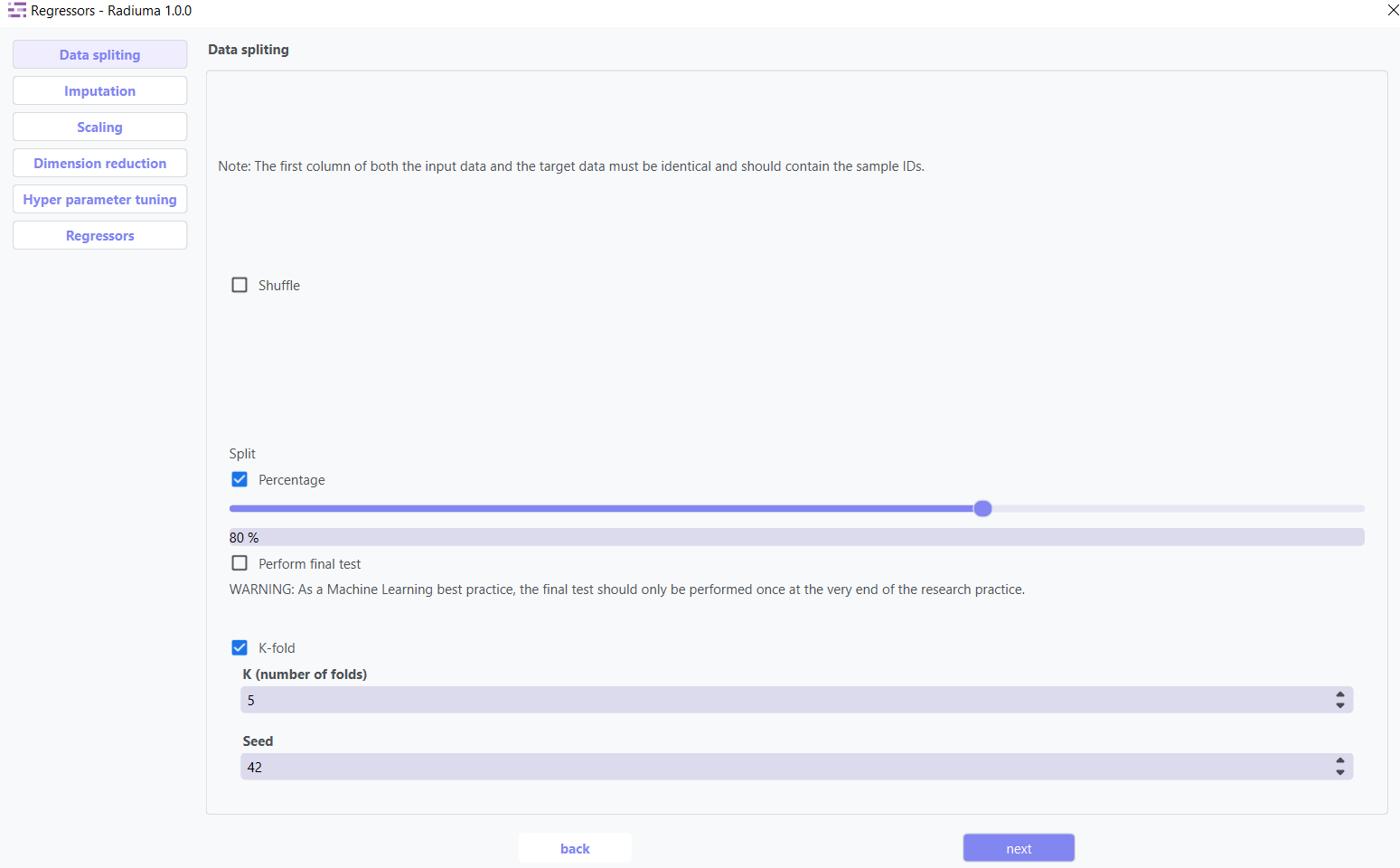
Important Note :
Data Requirement: The first column of both the input data and the target data must contain identical sample IDs.
Data Splitting Options:
Shuffle: Enable shuffling to randomize the data before splitting
Split: Choose between percentage split or K-fold cross-validation
Percentage: Specify training data percentage (e.g., 80%)
K-fold: Set the number of folds for cross-validation
Perform Final Test: Option to reserve data for final testing
Imputation
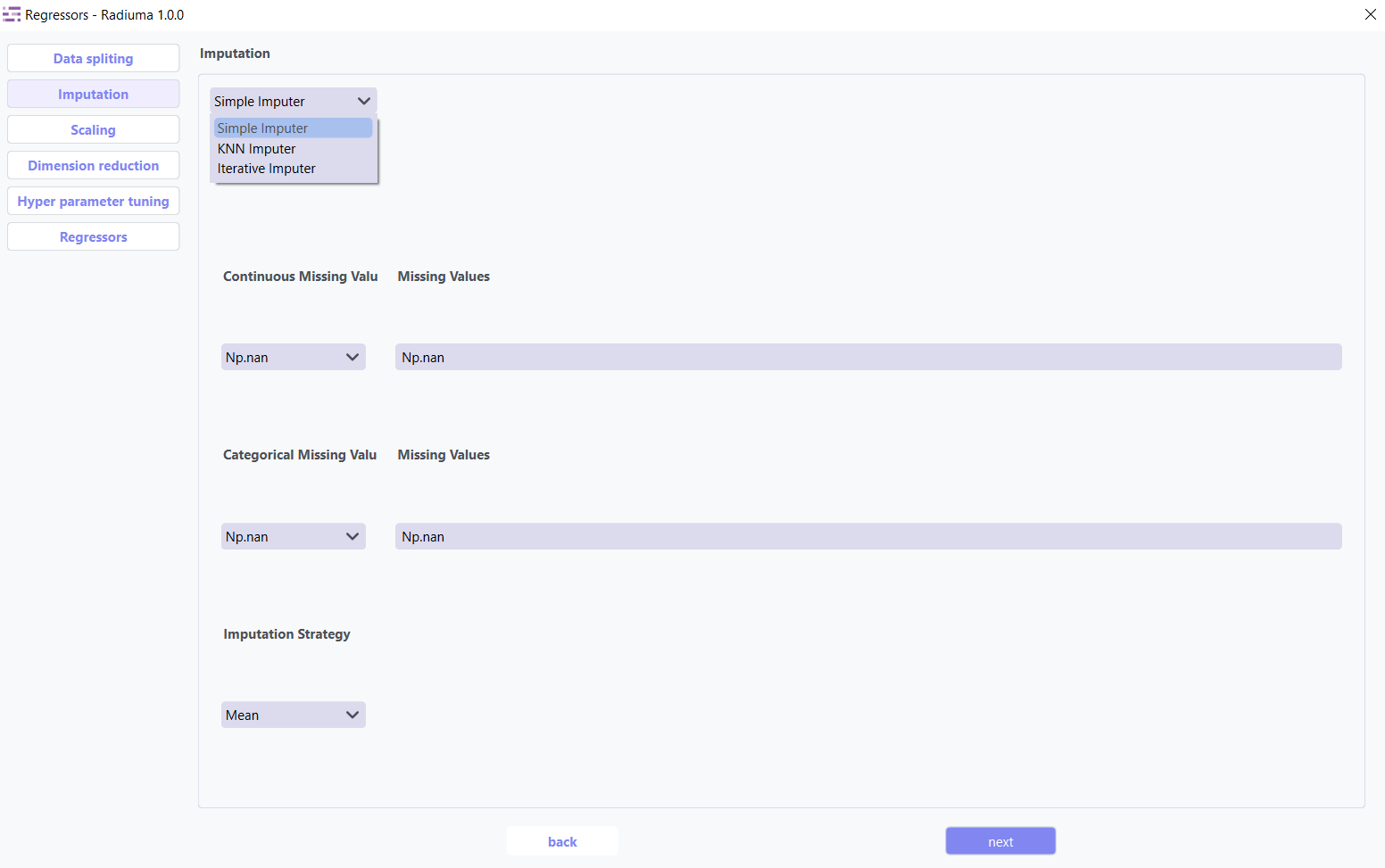
The imputation step addresses missing values in your dataset by replacing them with calculated values using three advanced strategies: Simple Imputer, KNN Imputer, and Iterative Imputer. Options include mean, median, or mode imputation for categorical data, ensuring your classification models have complete datasets for accurate predictions.
Simple Imputer: Basic replacement strategies for quick handling of missing data.
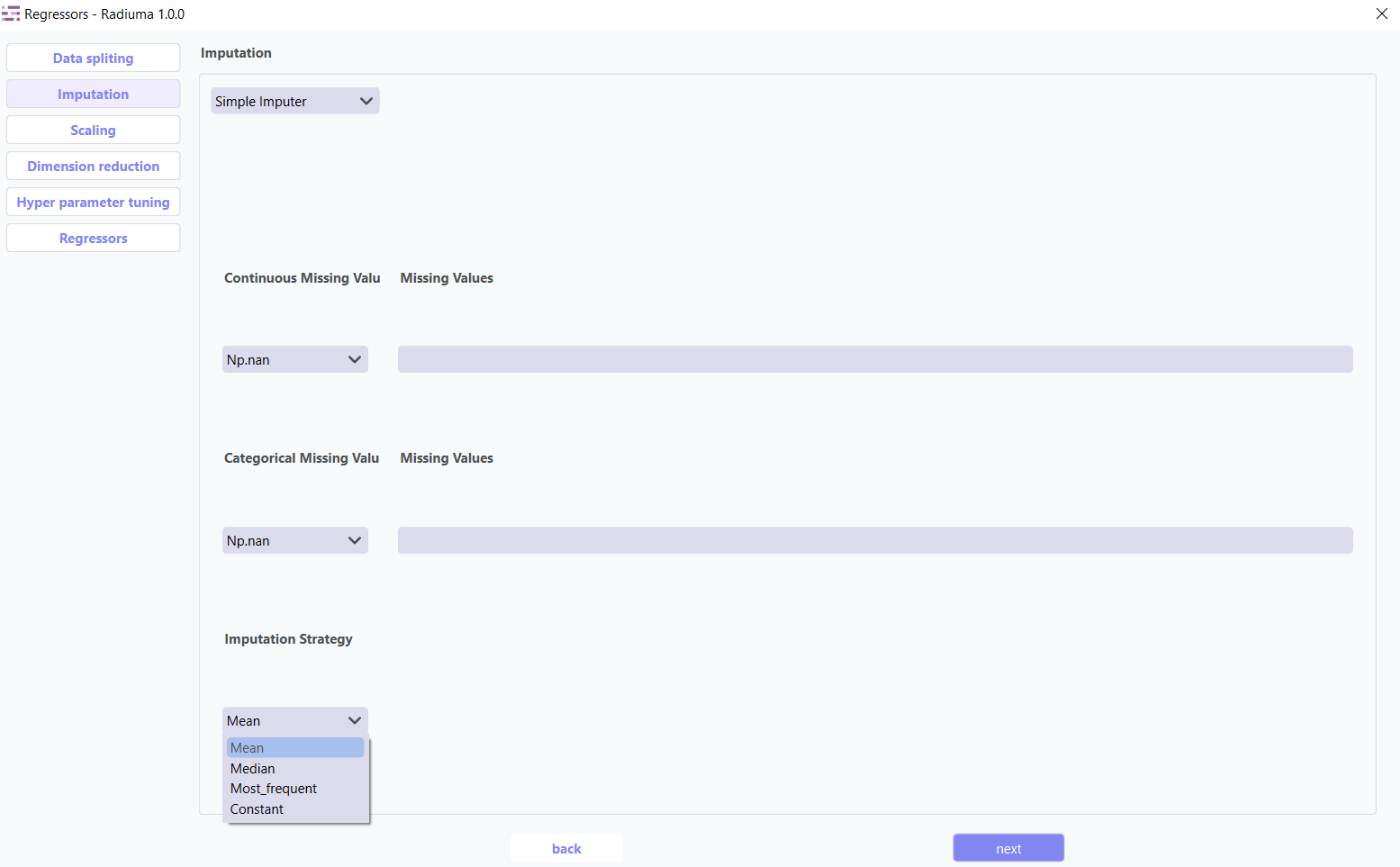
Imputation Options:
Continuous Missing Value: Strategy for handling missing numerical values
Categorical Missing Value: Strategy for handling missing categorical values
Imputation Strategy:
Mean: Replace with feature mean
Median: Replace with feature median
Most Frequent: Replace with most common value
Constant: Replace with user-specified value
KNN Imputer: Nearest-neighbor based imputation using feature similarity.
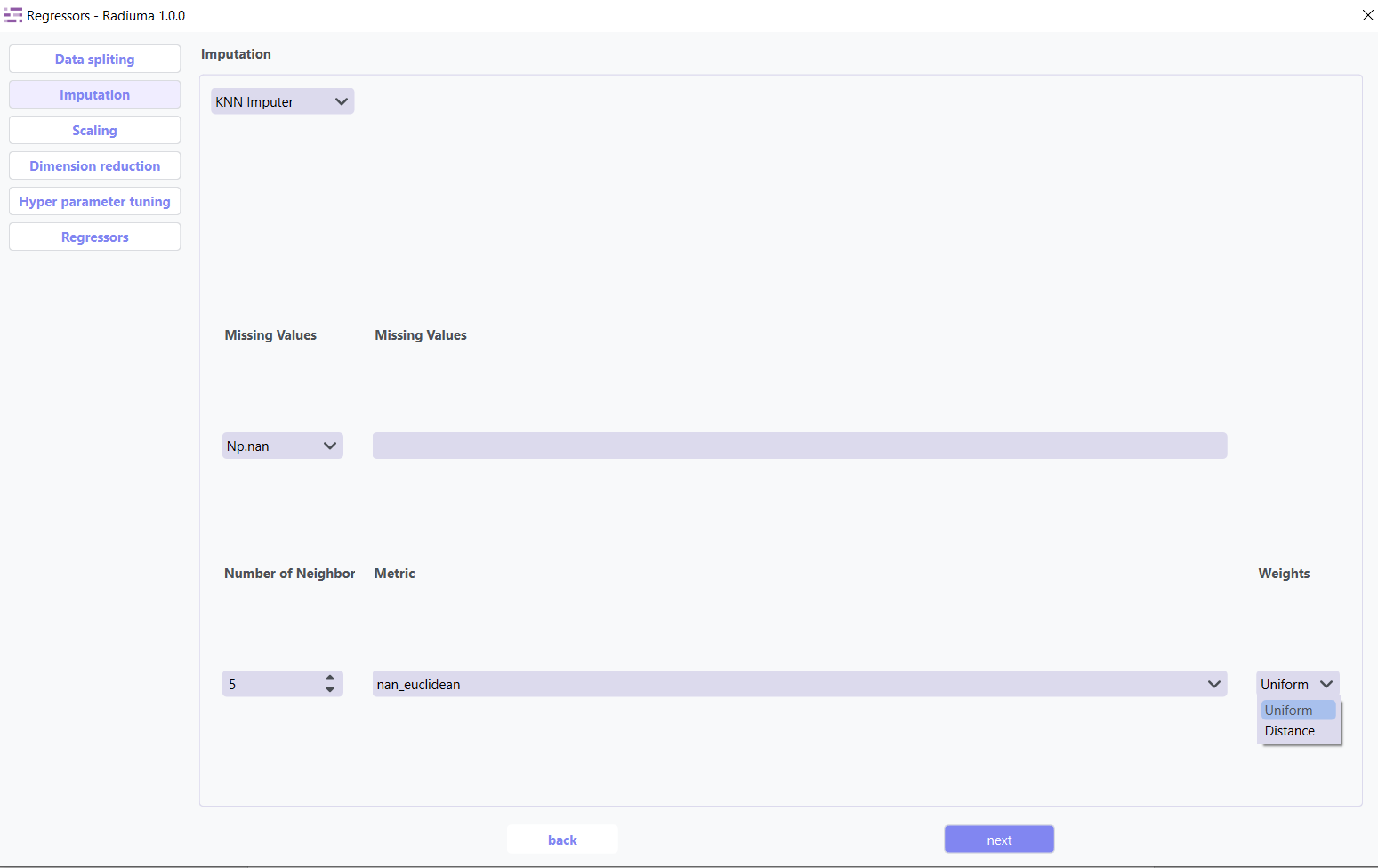
Key Parameters:
n_neighbors (default: 5) – Number of neighbors used to impute missing values
metric – Distance function non-euclidean,
weights – uniform or distance (distance gives more weight to closer neighbors)
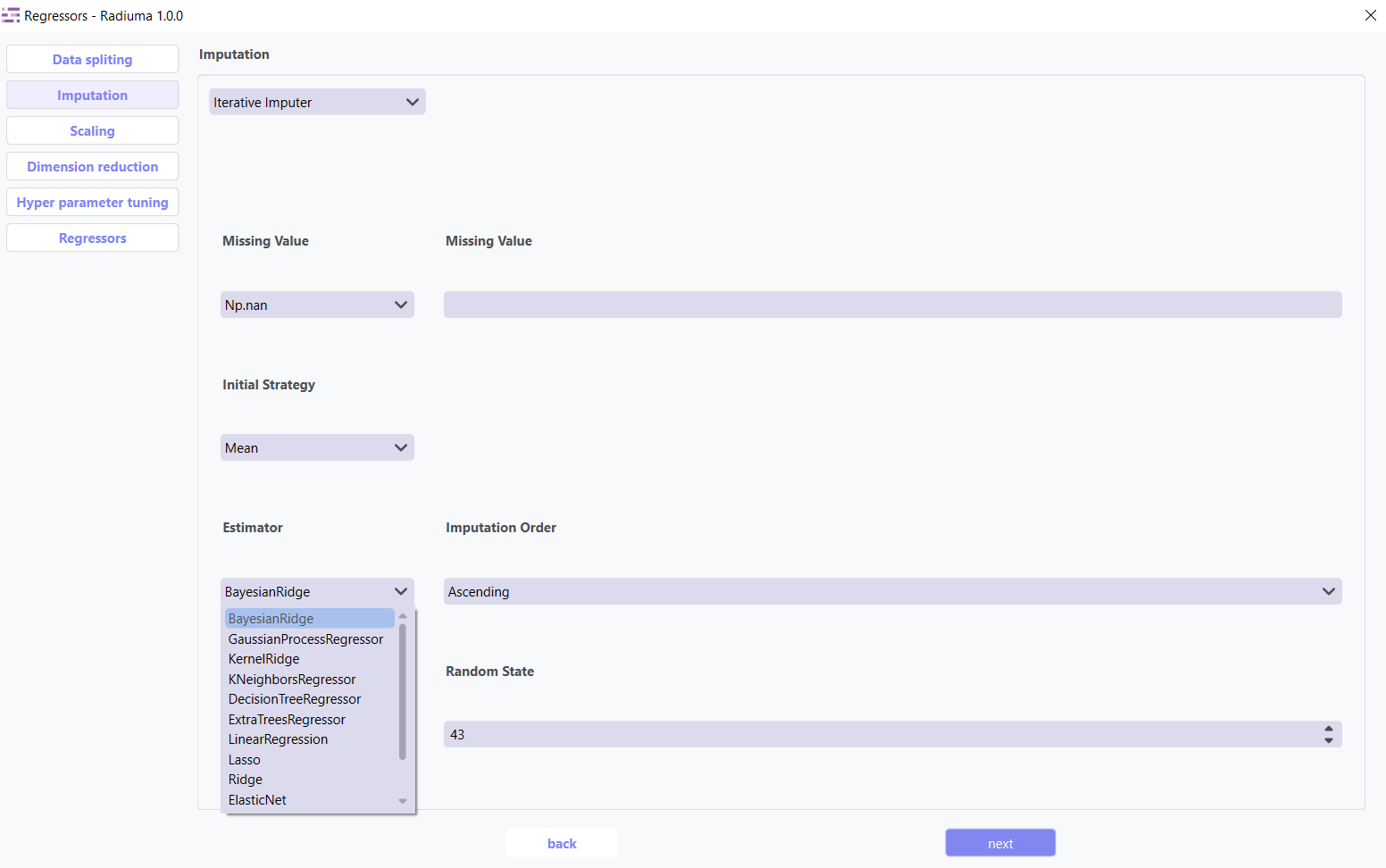
Iterative Imputer: Advanced method that models each feature with missing values as a function of other features.
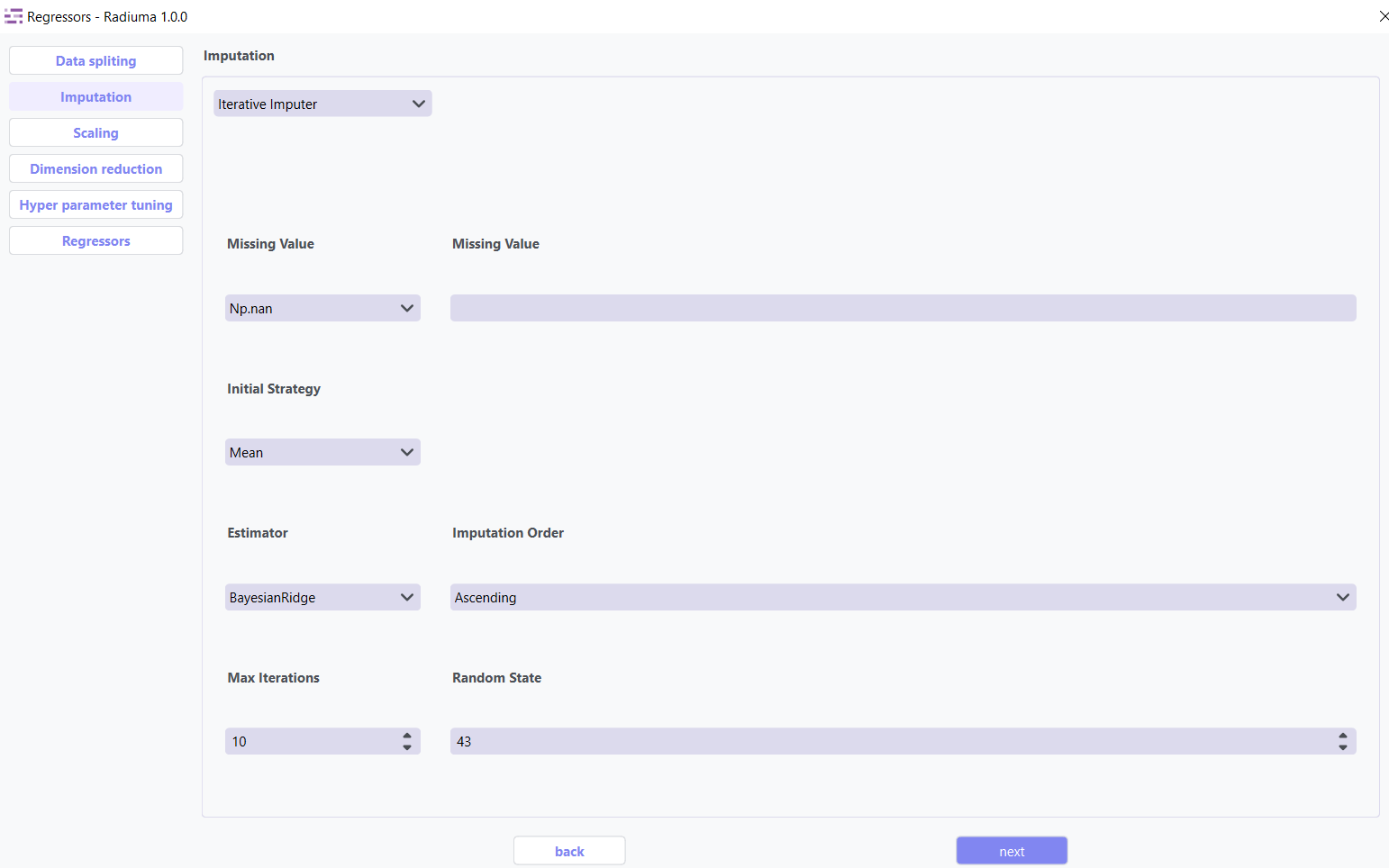
Key Parameters:
Estimator Algorithm used to predict missing values for each feature.
Common options include:
BayesianRidge (default) – Performs regularized linear regression using Bayesian principles
GaussianProcessRegressor – Models non-linear relationships with probabilistic output
KernelRidge – Combines ridge regression with kernel tricks for non-linear features
KNeighborsRegressor – Uses neighboring samples to estimate missing values
LinearRegression – Basic linear approach for imputation
Lasso / Ridge / ElasticNet – Regularized linear models for better generalization
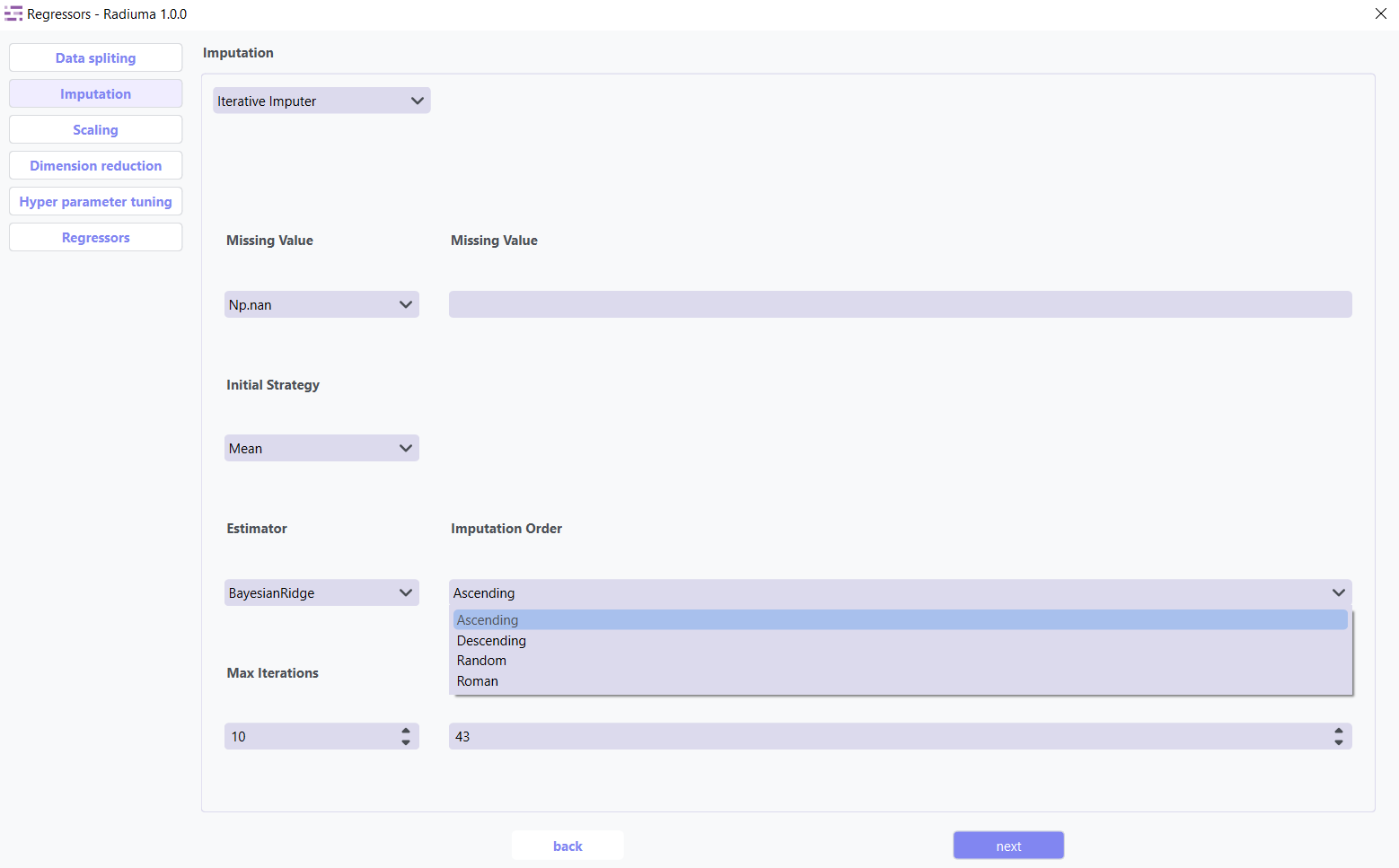
Imputation Order Determines the sequence in which features are imputed:
Ascending (default) – Start from features with fewest missing values
Descending – Start from features with most missing values
Random – Random order for each iteration
Roman – Left-to-right (fixed order)
Scaling

Feature scaling transforms your features to a common scale, which is essential for many classification algorithms that are sensitive to feature magnitudes. Methods like StandardScaler, MinMaxScaler,Max abs Scaler,Normalizer and RobustScaler help improve model convergence and performance.
Dimention Reduction
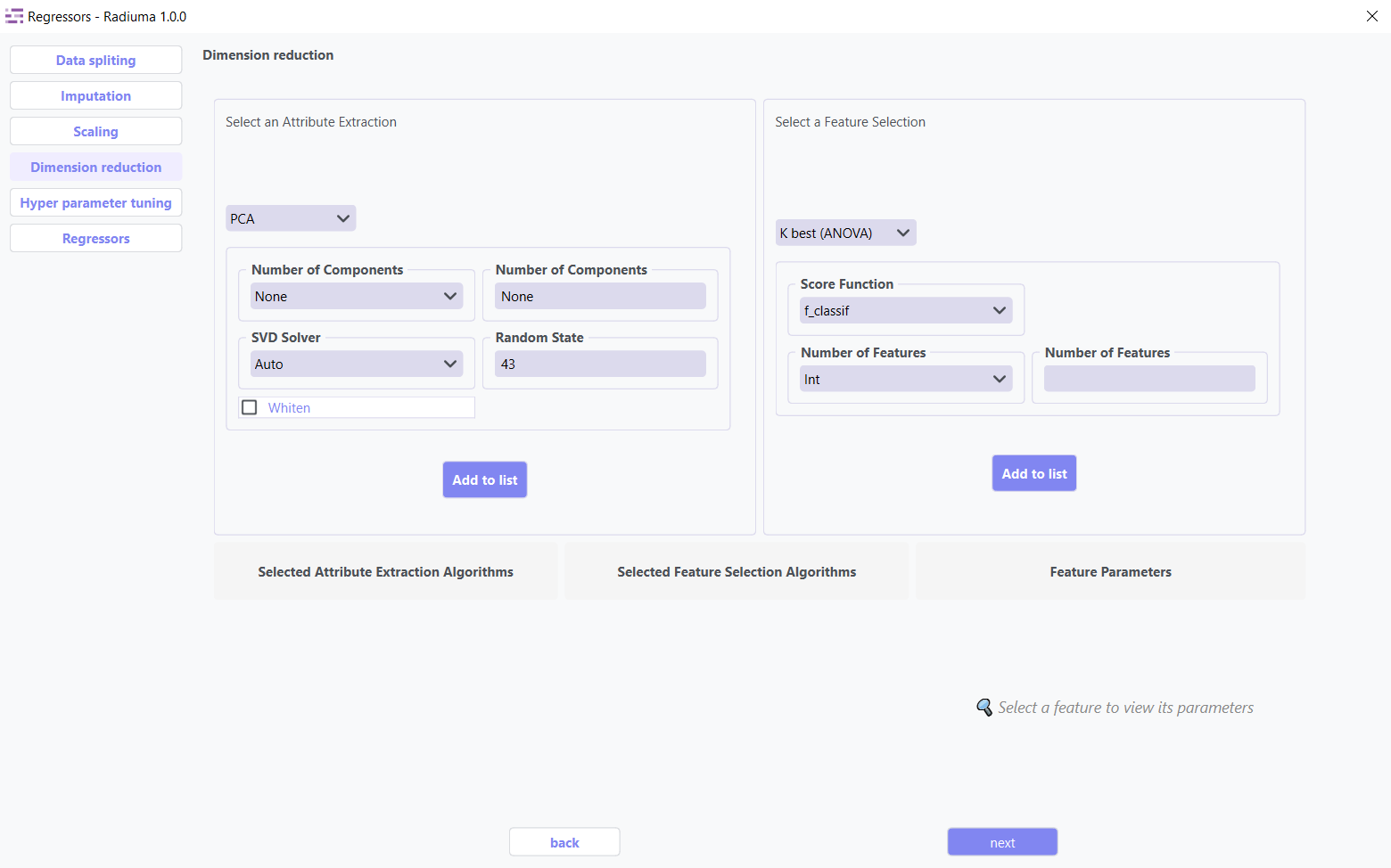
Dimension reduction techniques optimize your dataset by identifying and retaining only the most valuable features. These methods serve two primary purposes:
Attribute Extraction: Transforms features into a more compact representation while preserving essential patterns
Feature Selection: Identifies and keeps only the most informative original features
Key Benefits:
Reduces computational requirements and training time
Improves model performance by eliminating noise
Helps prevent overfitting
Enhances interpretability of results
1. Attribute Extraction Algorithms
Transform features into a lower-dimensional space while retaining patterns:
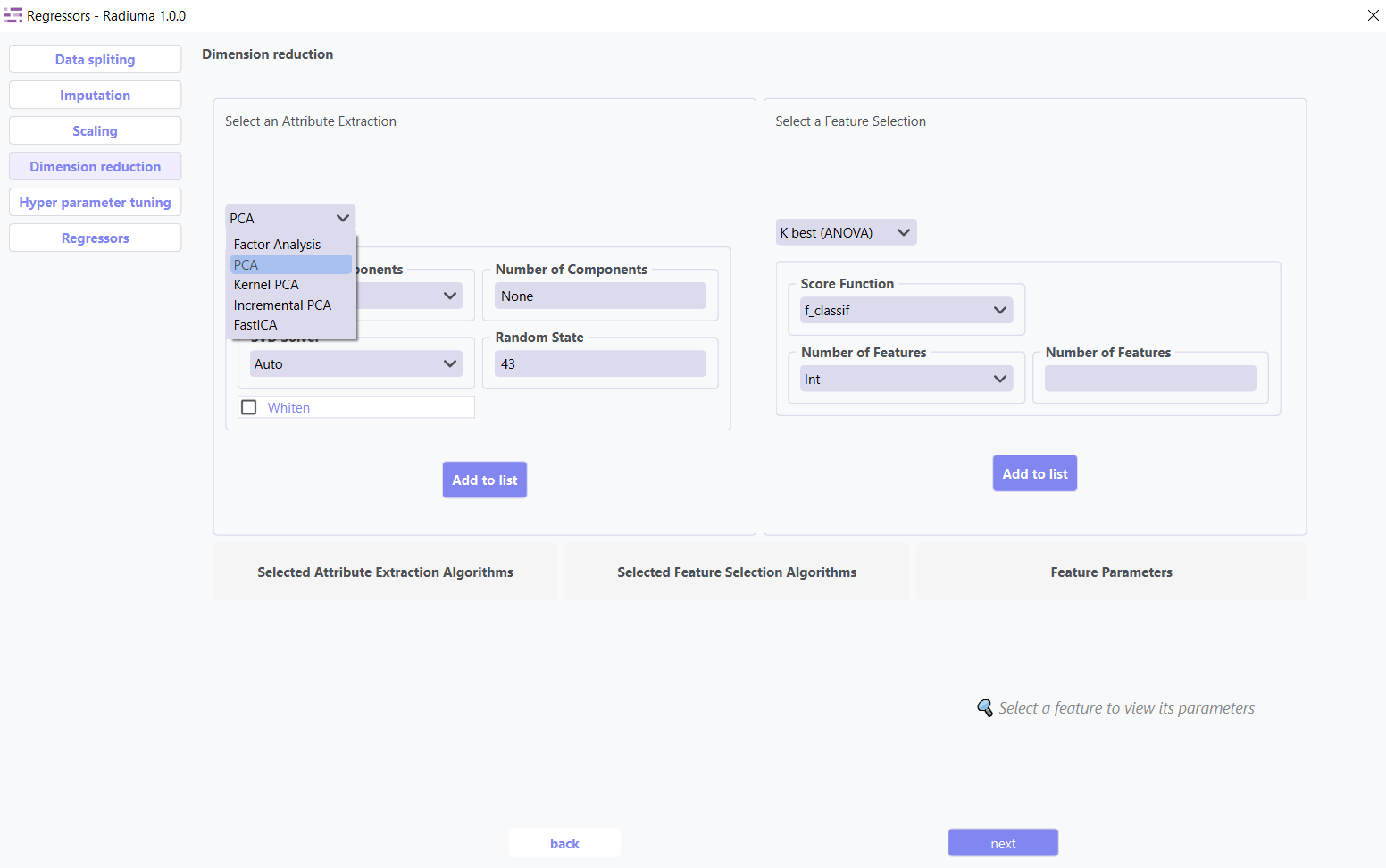
Available Methods:
PCA (Principal Component Analysis): Linear dimensionality reduction via orthogonal transformation
Kernel PCA: Non-linear extension of PCA using kernel functions
Factor Analysis: Models observed variables as linear combinations of latent factors
FastICA: Independent Component Analysis for signal separation
Incremental PCA: Efficient PCA for large, streaming datasets
2. Feature Selection Algorithms
Select the most relevant features without transformation:
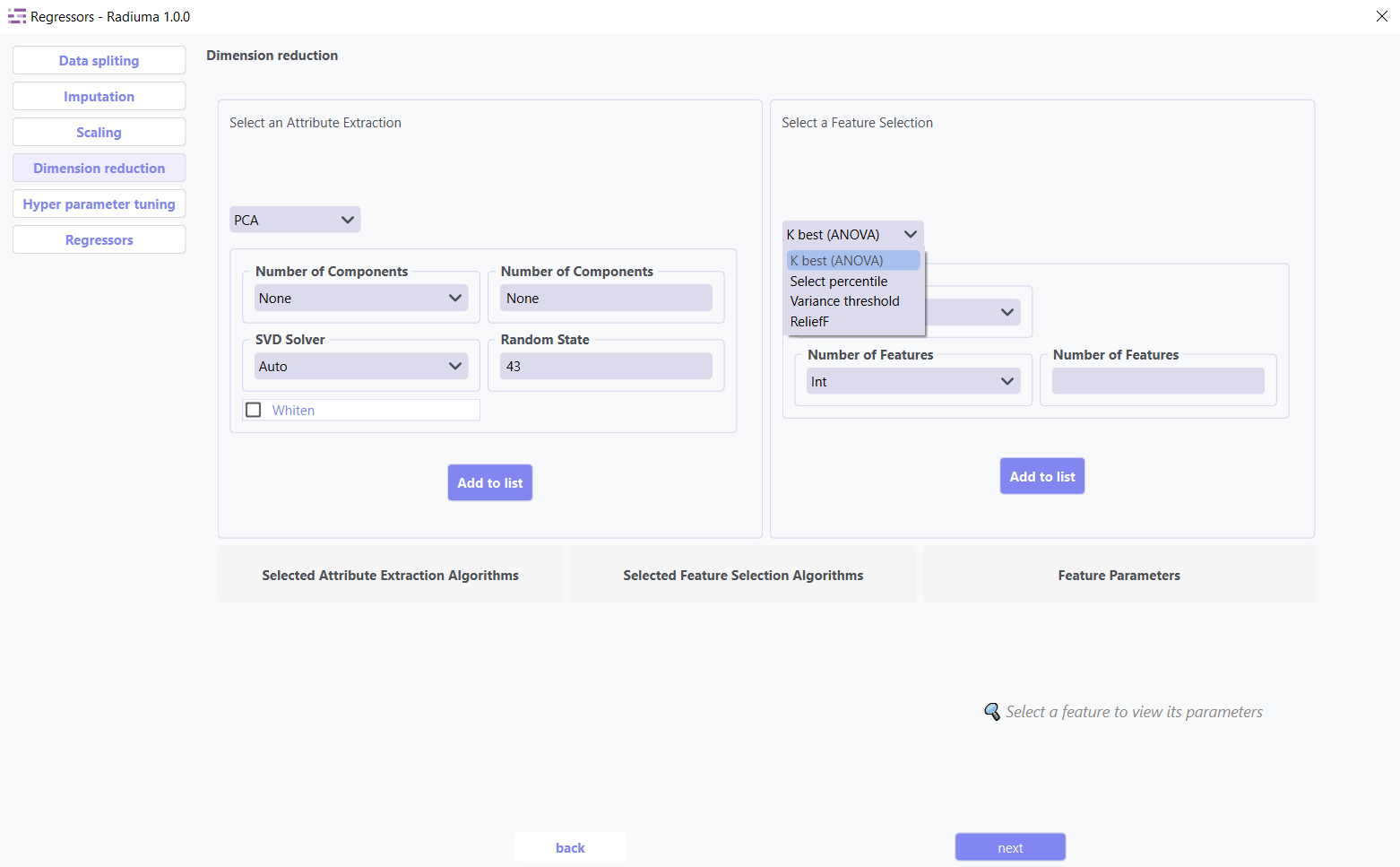
Available Methods:
K-Best(ANOVA): Select top k features based on statistical tests
Select Percentile: Keep top features above a specified percentile
ReliefF: Weight-based feature selection for multi-class problems
Variance Threshold: Remove low-variance features (user-defined threshold)
Hyperparameter Tuning
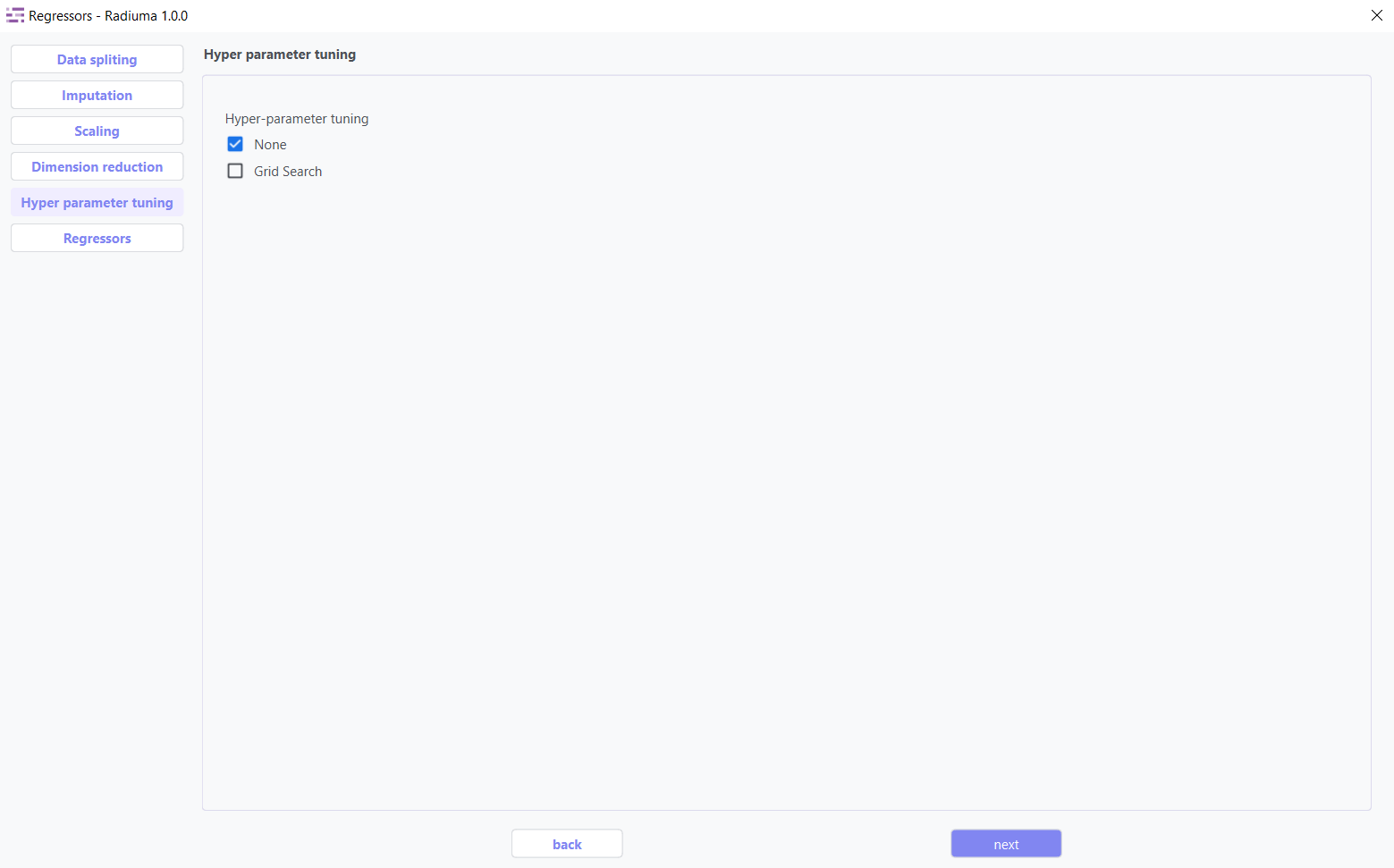
Hyperparameter tuning systematically searches for the optimal model configuration to maximize classification performance. Using methods like grid search or random search, this step fine-tunes algorithm-specific parameters that cannot be learned directly from the data.
Regressor Selection
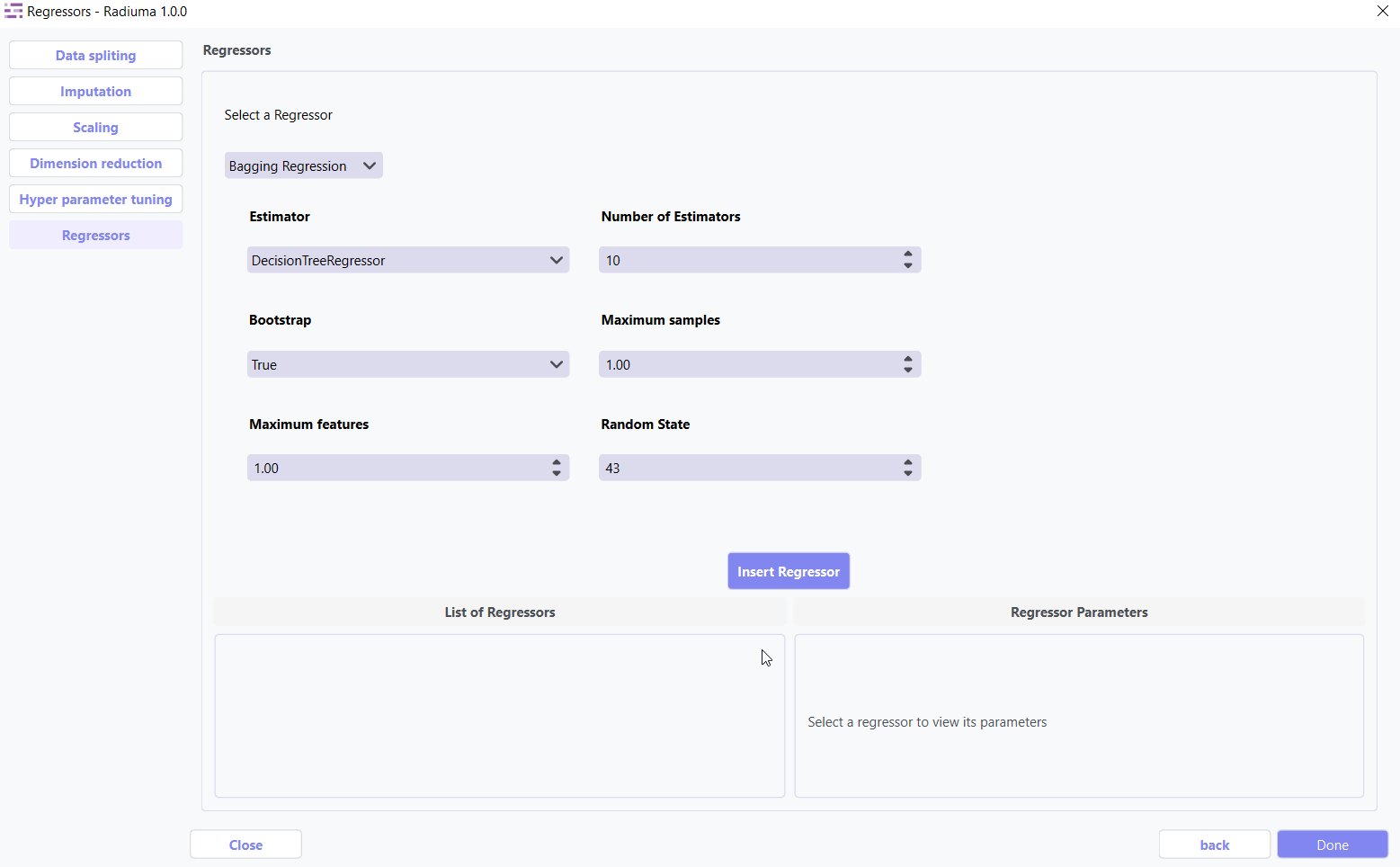
The algorithm selection interface allows you to choose and configure the appropriate regression model for your specific data characteristics and predictive goals.
Supported Algorithms
1. Bagging Regression
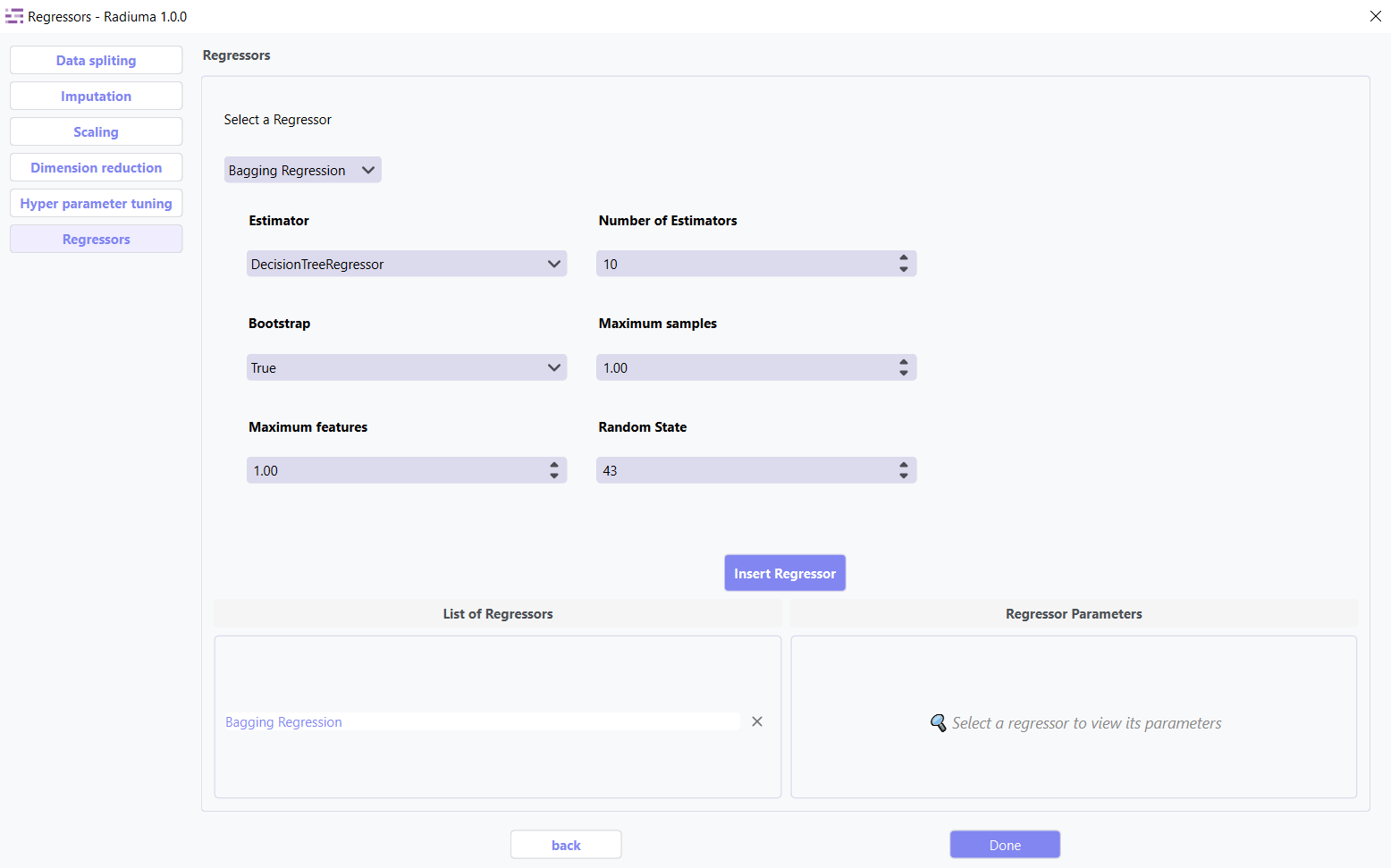
Ensemble method aggregating predictions from multiple models.
Key Parameters:
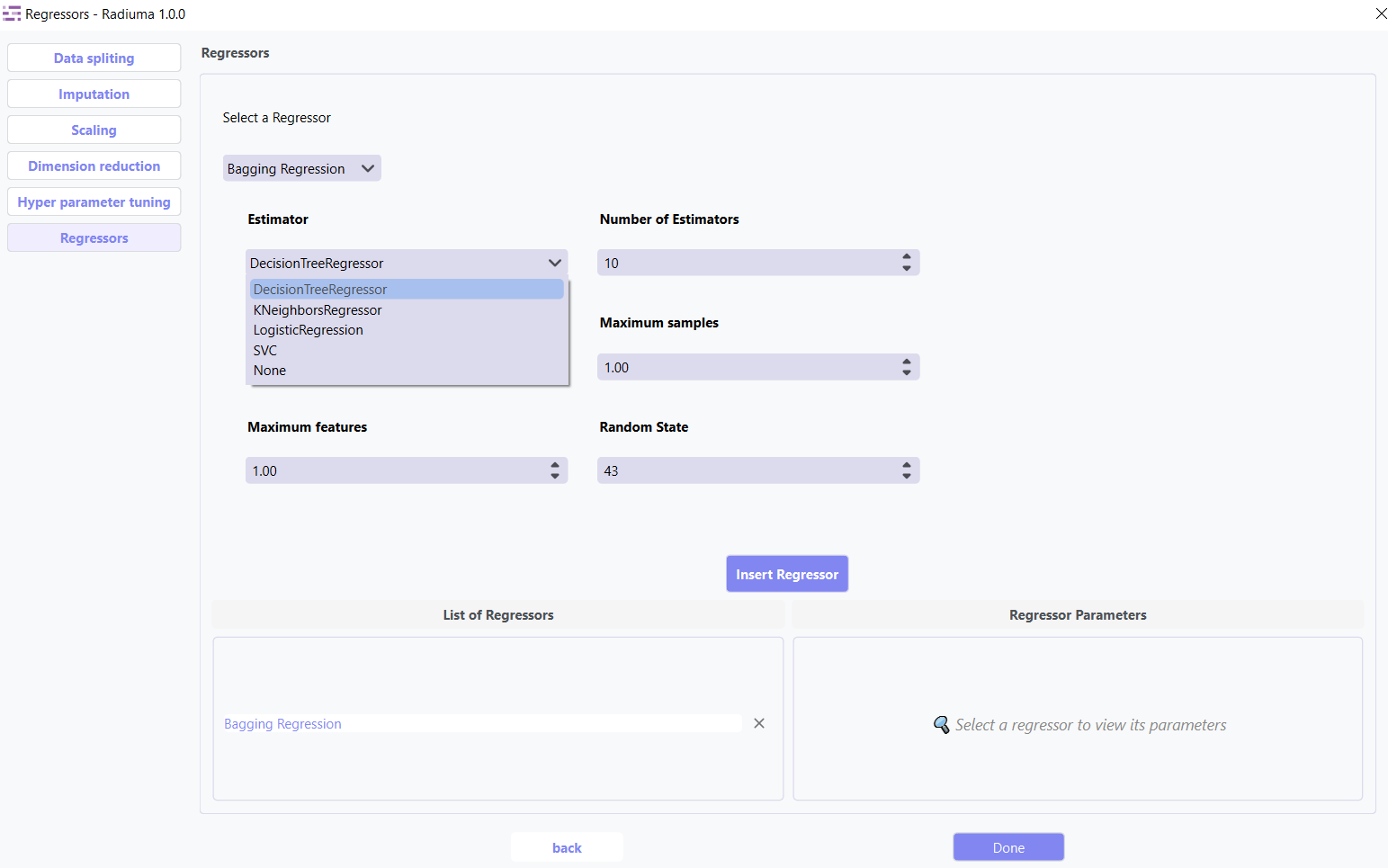
Base Estimator: Base regressor type (DecisionTreeRegressor, SVR, etc.)
Number of Estimators: Number of base estimators (default: 10)
Max Samples: Samples per base estimator (default: 1.0)
Max Features: Features per base estimator (default: 1.0)
Bootstrap: Whether to sample with replacement (True/False)
Random State: Seed for reproducibility (default: 43)
2. AdaBoost Regression
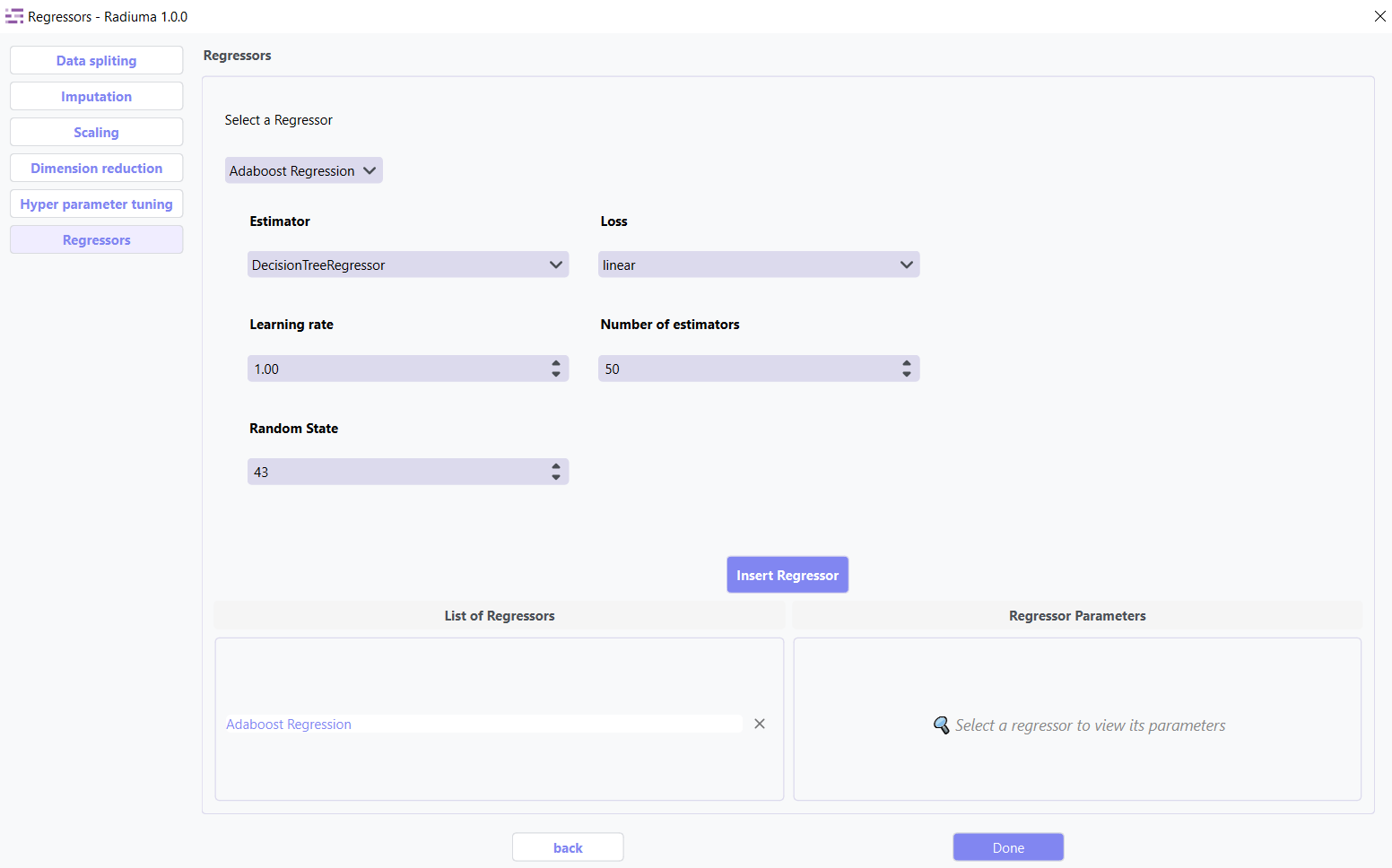
Ensemble method using weak regressors.
Key Parameters:
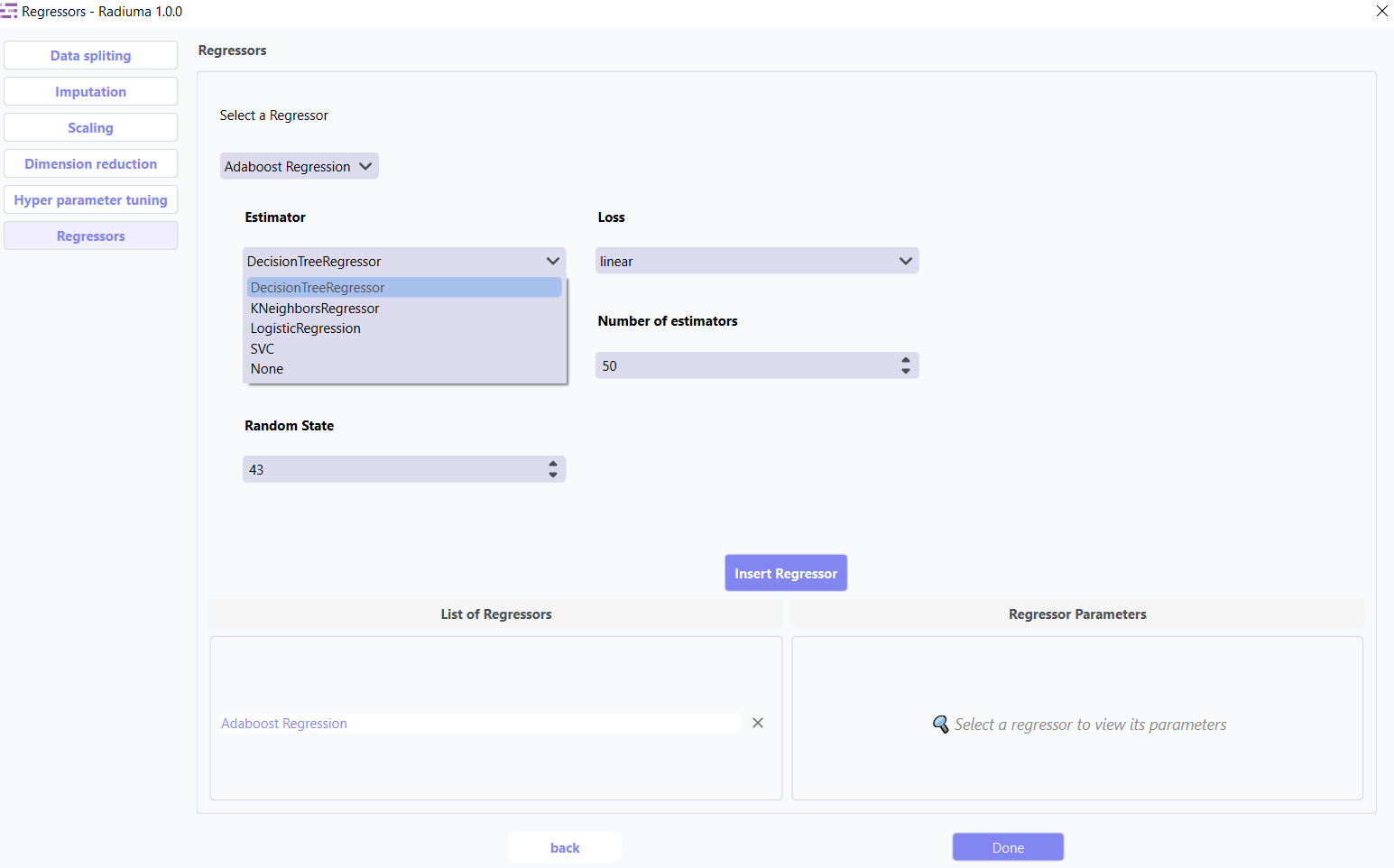
Base Estimator: Type of weak regressor (DecisionTreeRegressor, etc.)
Number of Estimators: Number of boosting stages (default: 50)
Learning Rate: Weight applied to each regressor (default: 1.0)
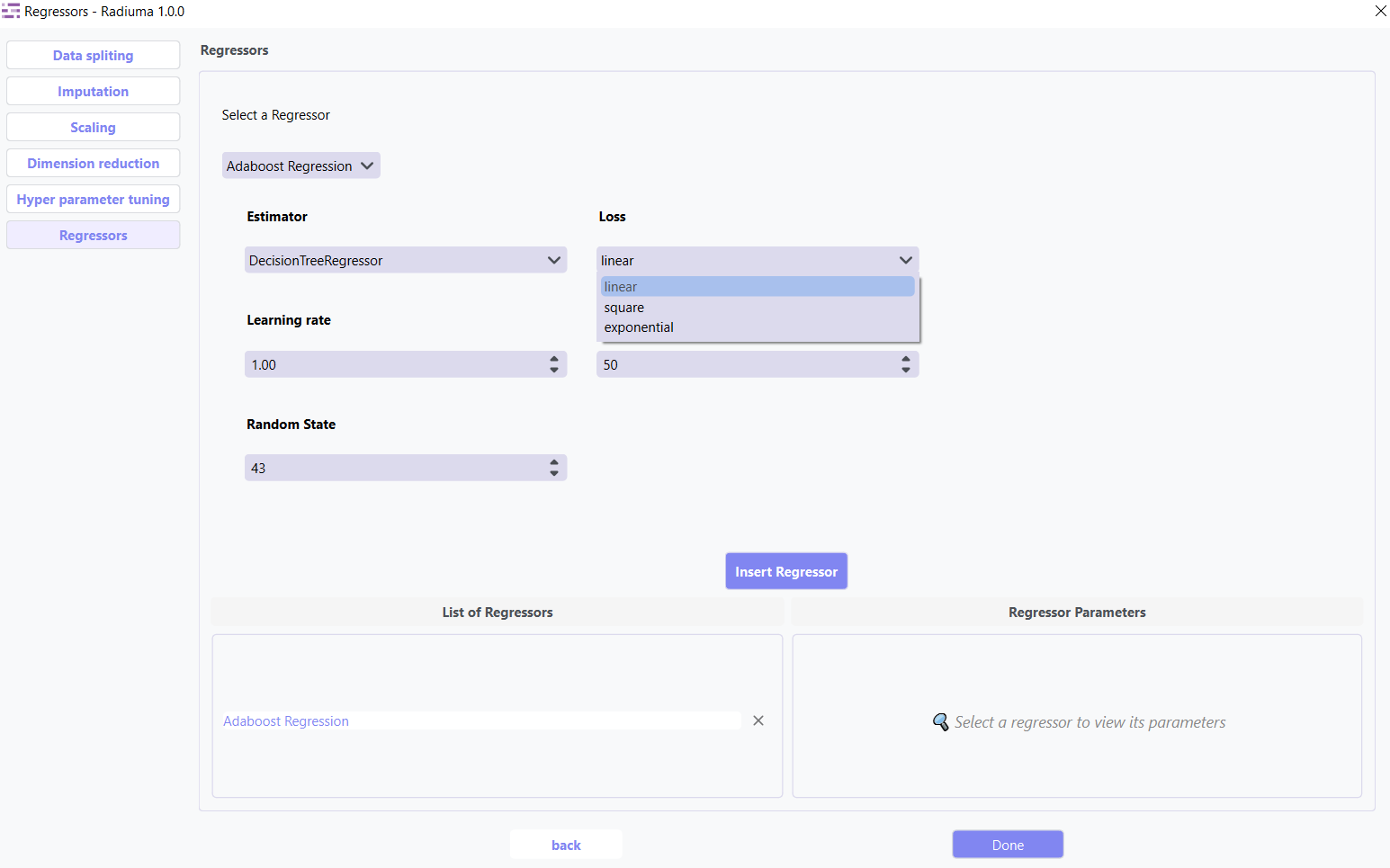
Loss: Loss function (linear, square, exponential)
Random State: Seed for reproducibility (default: 43)
3. Lasso Regression
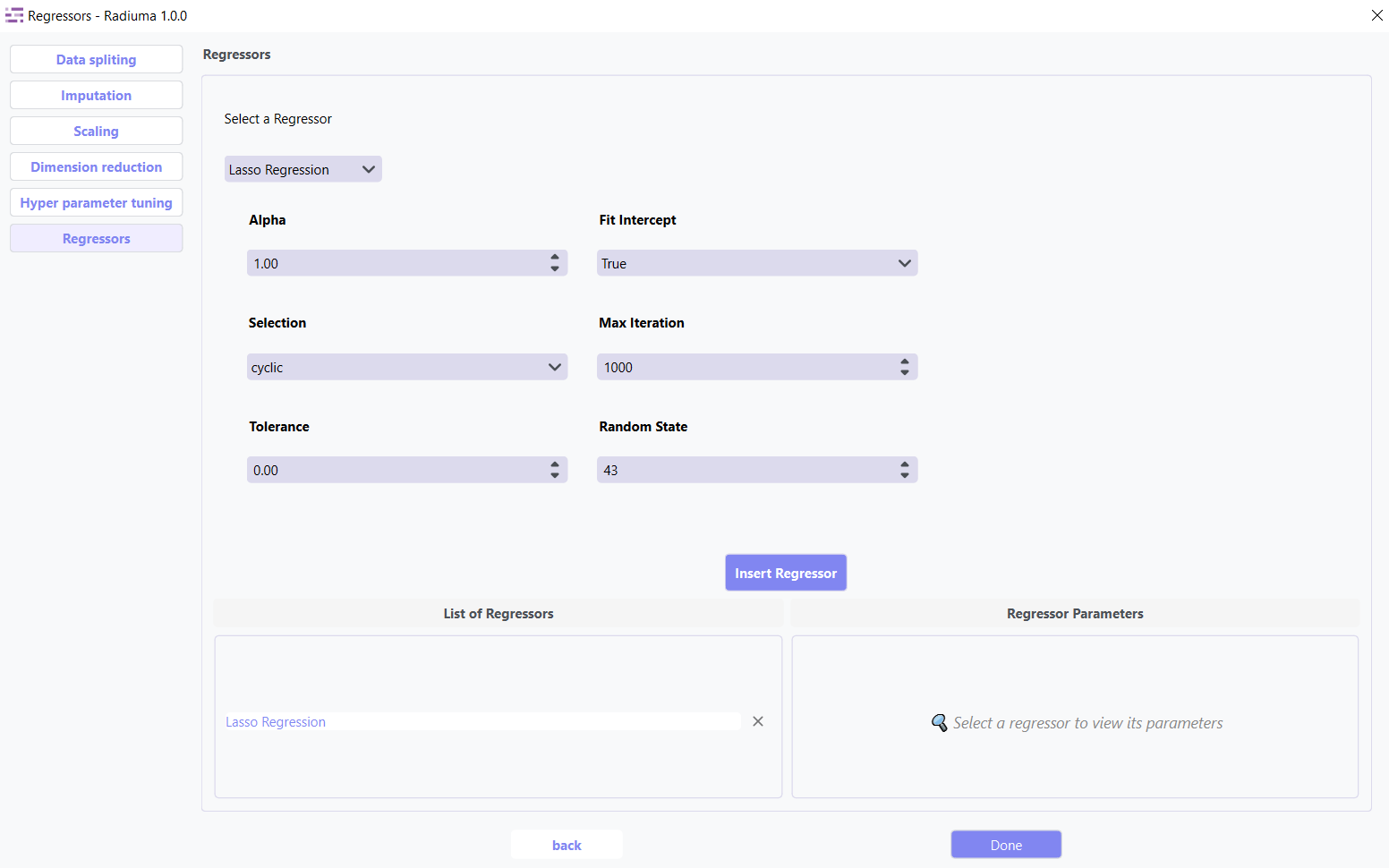
Linear model with L1 regularization promoting sparse coefficients.
Key Parameters:
Alpha: Regularization strength (default: 1.0)
Fit Intercept: Whether to calculate the intercept (default: True)
Max Iterations: Maximum iterations for solver (default: 1000)
Tolerance: Precision of the solution (default: 0.0001)
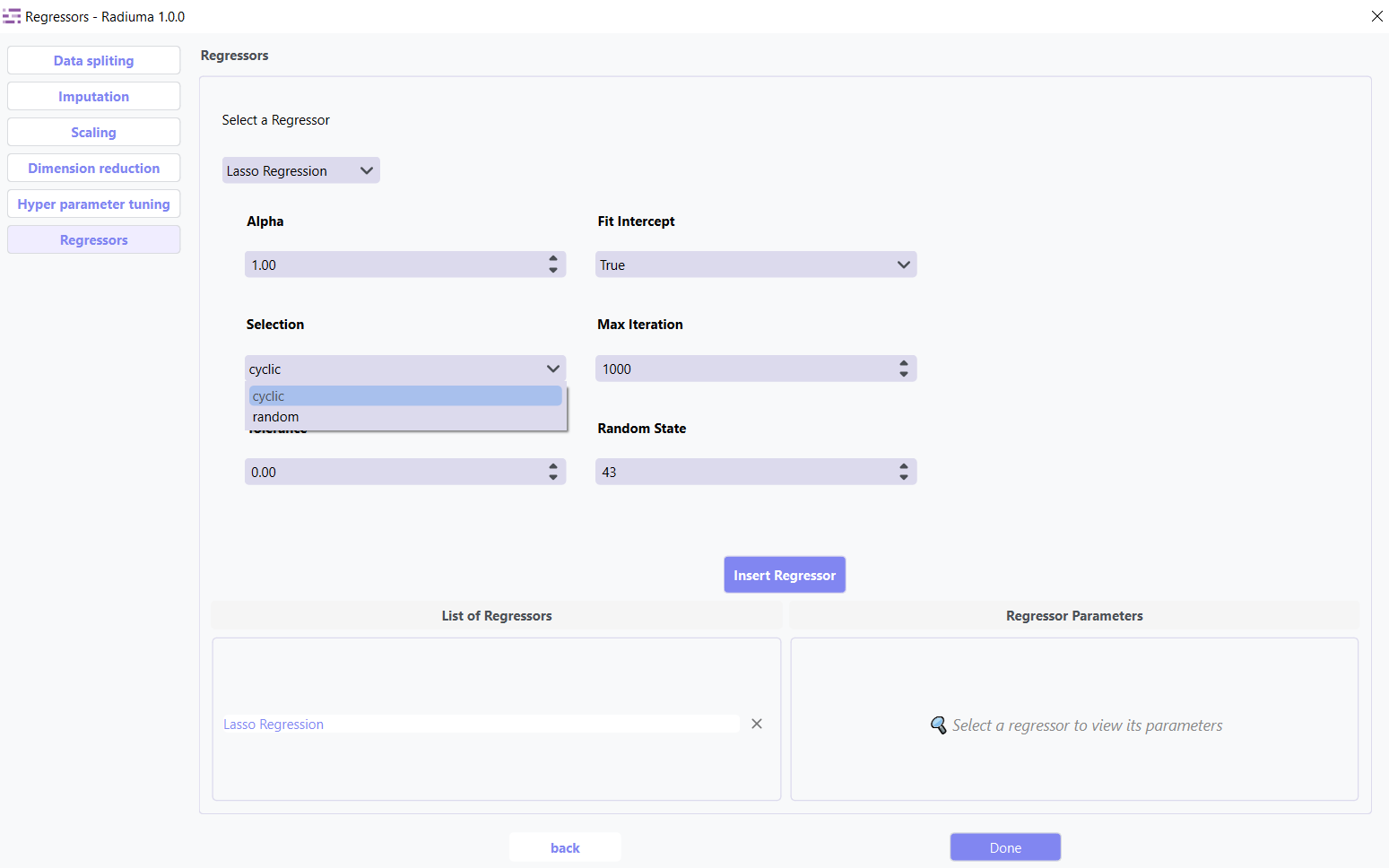
Selection: Feature selection method (cyclic, random)
Random State: Seed for reproducibility (default: 43)
4. Ridge Regression
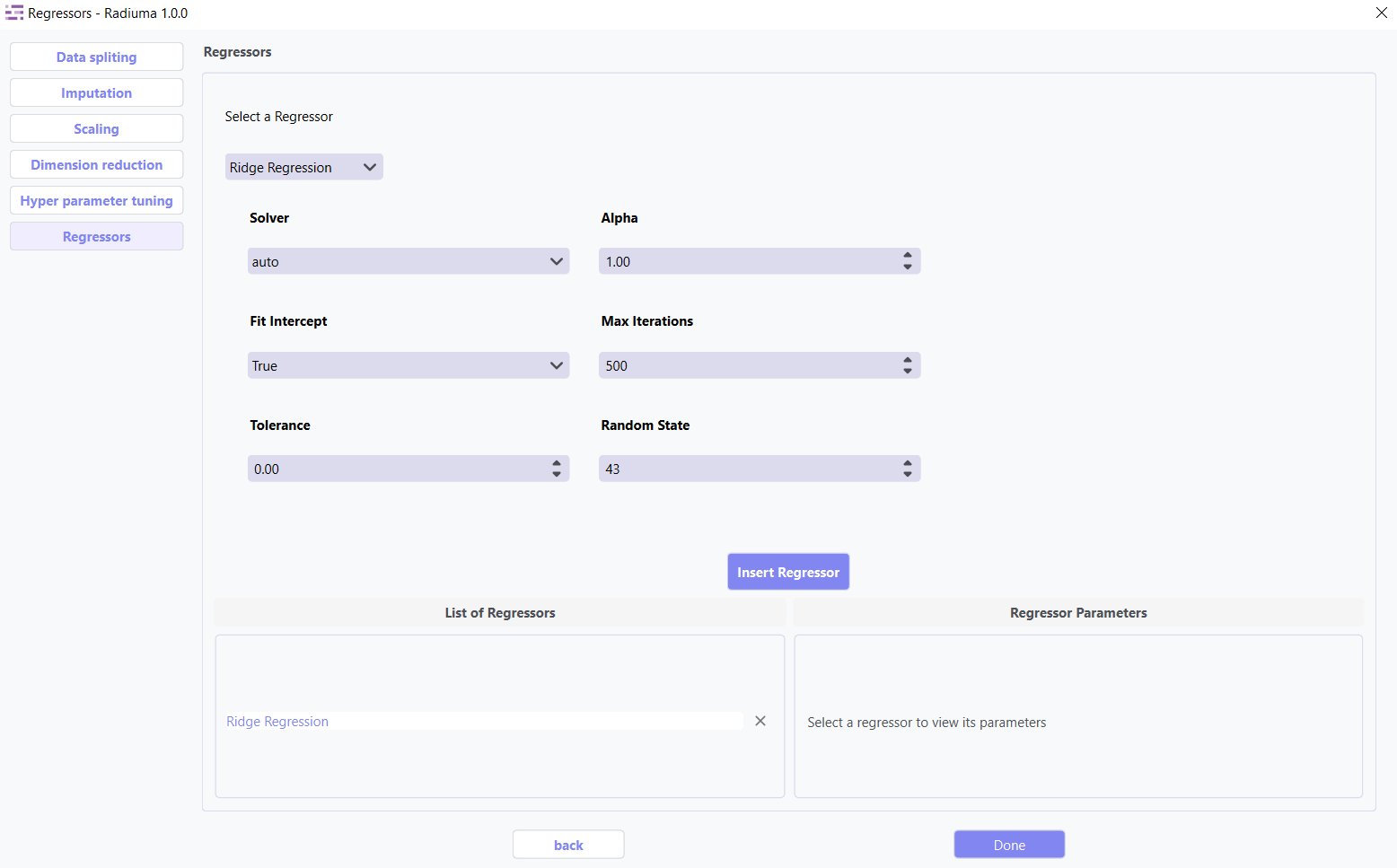
Linear model with L2 regularization to reduce overfitting.
Key Parameters:
Alpha: Regularization strength (default: 1.0)
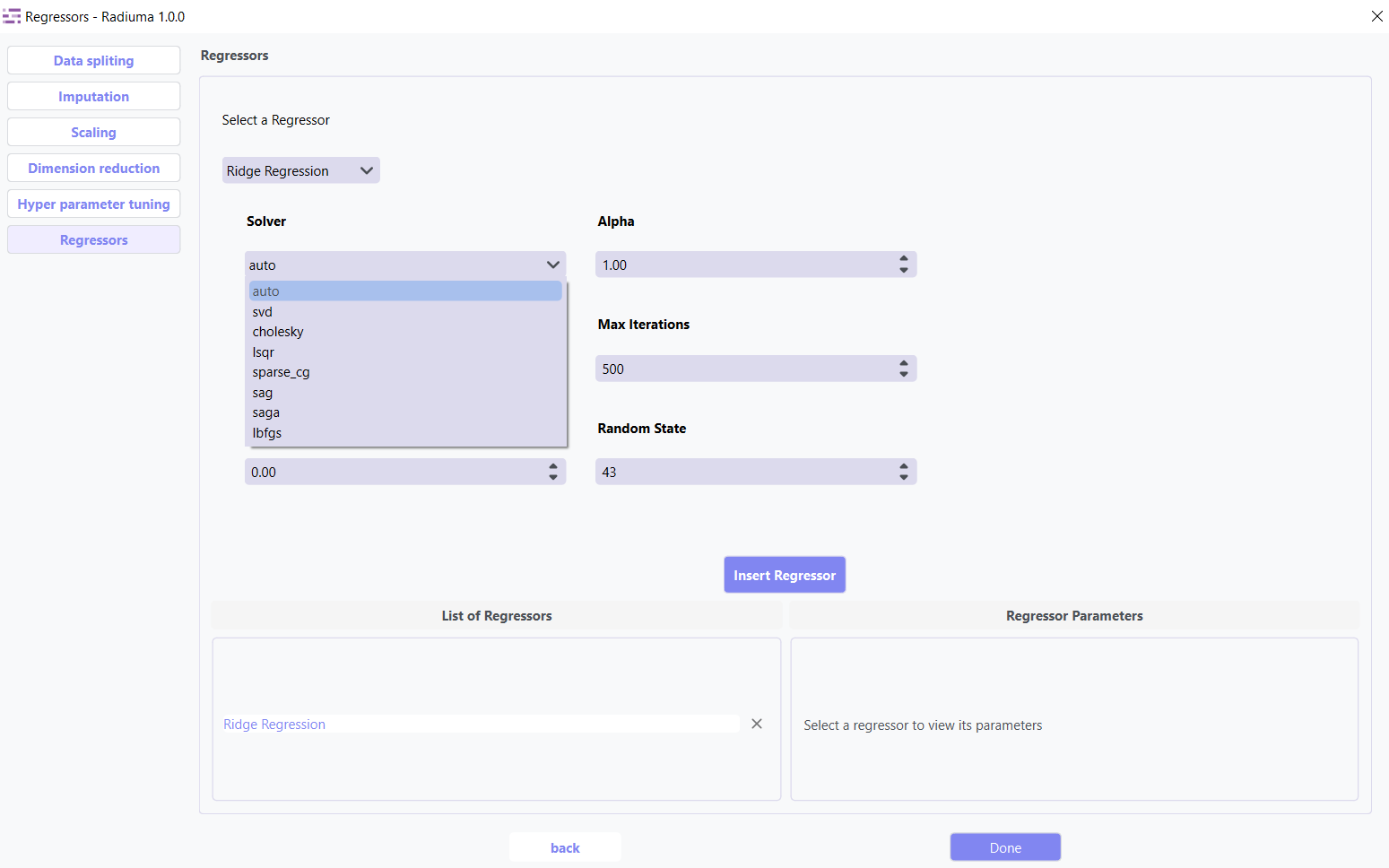
Solver: Method for computation (auto, svd, cholesky, lsqr, sparse_cg, etc.)
Fit Intercept: Whether to calculate the intercept (default: True)
Max Iterations: Maximum iterations for solver (default: 500)
Tolerance: Precision of the solution (default: 0.0001)
Random State: Seed for reproducibility (default: 43)
5. Linear Regression
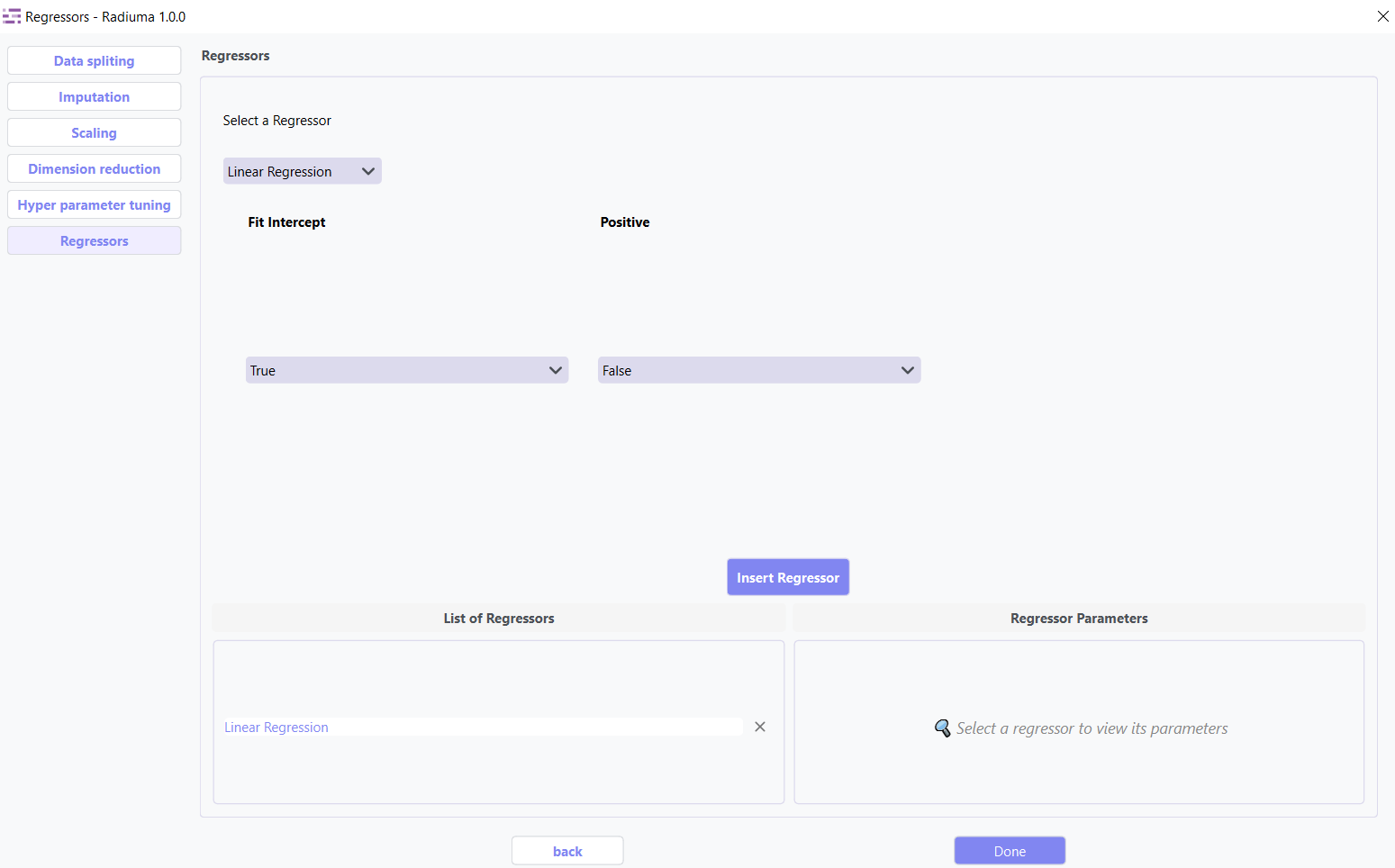
Standard approach estimating linear relationships between variables.
Key Parameters:
Fit Intercept: Whether to calculate the intercept (default: True)
Positive: Force coefficients to be positive (default: False)
Evaluation Metrics
After training, Radiuma automatically computes standard Regression metrics:
Mean Absolute Error (MAE): Average of absolute differences between predictions and actual values
Root Mean Squared Error (RMSE): Square root of average squared differences
R-squared Score: Proportion of variance explained by the model
Median Absolute Error: Median of absolute differences between predictions and actual values
Regression Workflow
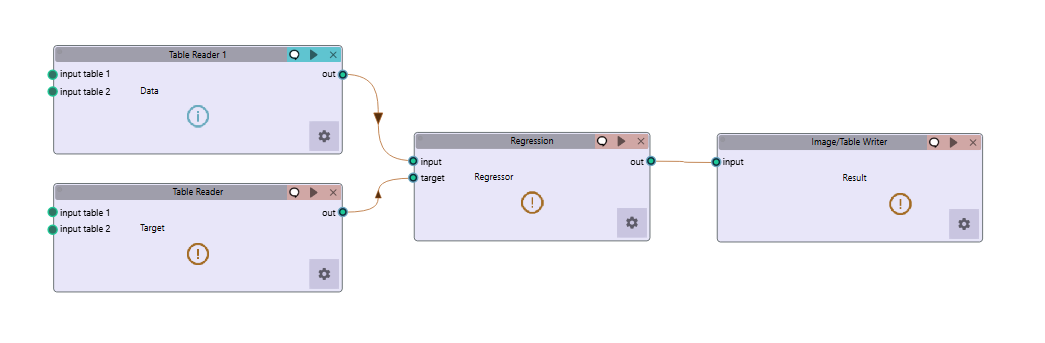
Quick Workflow Summary:
Example Workflow: Download the Regression workflow
Import data using Table Reader.
Verify sample IDs match between feature and target tables.
Apply Data Splitting (shuffle, percentage, or K-fold).
Handle missing values using Imputation.
Apply Scaling and Dimension Reduction if needed.
Choose a Regressor and optionally perform Hyperparameter Tuning.
Evaluate using:
MAE,RMSE,R-squared Score,Median Absolute Error
Compare models and select the best one.
Regression Output
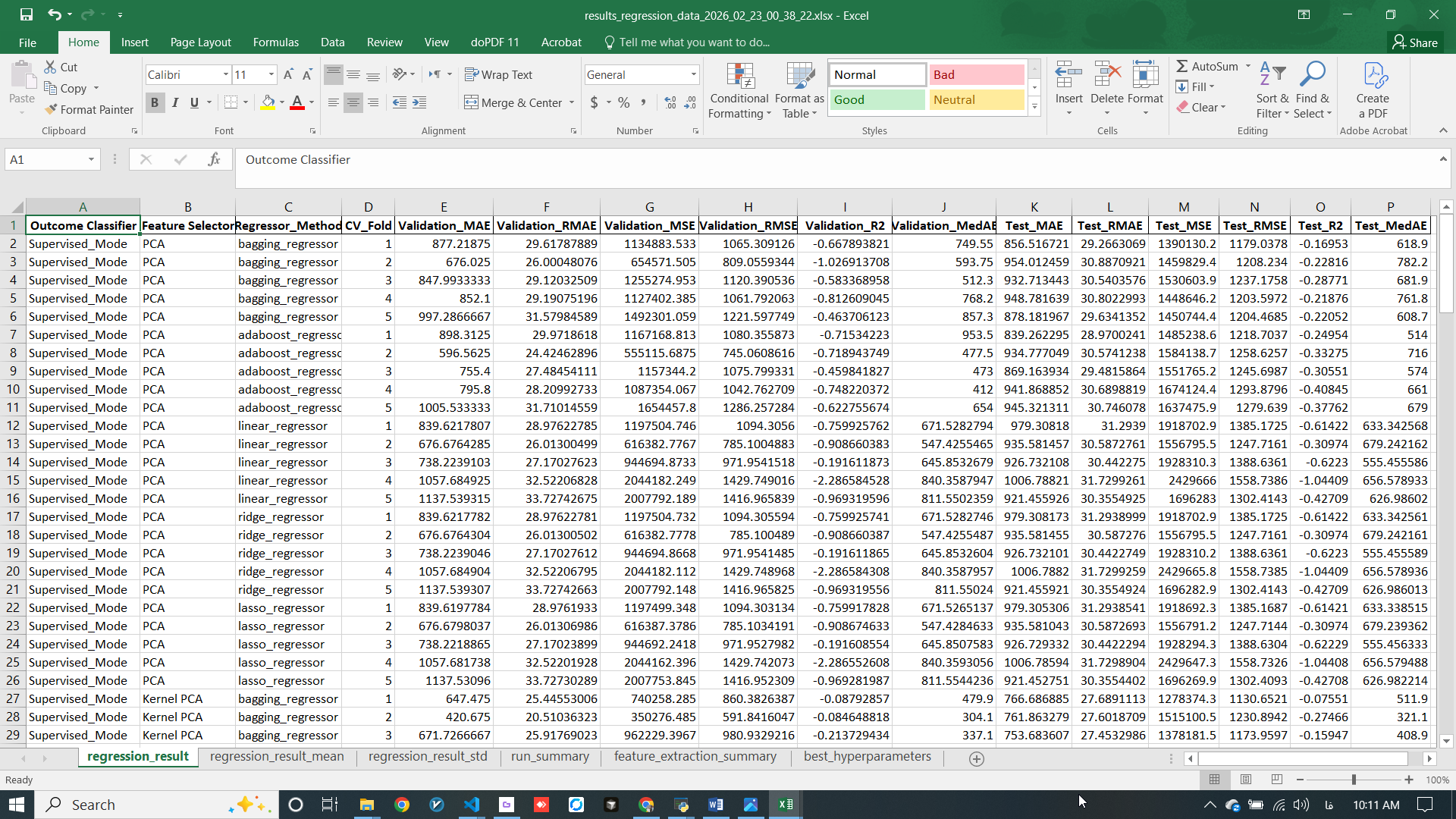
The Regression module provides comprehensive output including performance metrics, model comparisons, prediction visualizations, and detailed evaluation results to help you select the optimal regression model for your predictive modeling tasks.
Regression Pipeline
The Regression tool guides you through a complete workflow:
** Data Requirement: The first column of both the input data and the target data must contain identical sample IDs
1. Data Preprocessing
Train/Test Split: Divide data into training and testing sets
Feature Scaling: Standardize or normalize feature ranges
Missing Value Handling: Impute missing values with means, medians, or constants
2. Model Selection
Model Comparison: Compare performance of different regression algorithms
Hyperparameter Tuning: Find optimal parameter values
Cross-Validation: Evaluate model performance on multiple data splits
3. Model Evaluation
Performance Metrics: Calculate accuracy metrics on test data
Residual Analysis: Analyze prediction errors and identify patterns
Feature Importance: Evaluate contribution of each feature
Video Tutorial: Watch the step-by-step guide on YouTube: Regression | Predictive Modeling Workflow with Radiuma | Radiuma Tutorial