Image Registration
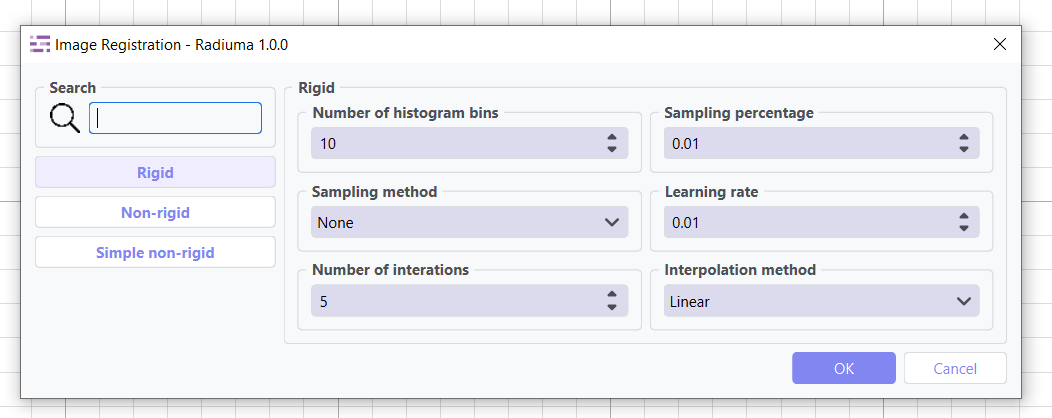
The Image Registration module provides a comprehensive spatial alignment interface within Radiuma for precisely aligning images from different modalities, time points, or viewing angles into a common coordinate system. This essential preprocessing tool enables direct comparison and integration of imaging data by correcting spatial differences and ensuring anatomical consistency across diverse imaging scenarios. Through an intuitive workflow, users can align complementary imaging types (CT, MRI, PET) for fused visualization and analysis, supporting both rigid registration for maintaining shape and size through rotation and translation, and deformable registration techniques for local tissue adjustments—making it indispensable for multi-modal studies, longitudinal tracking, treatment response assessment, and surgical planning applications in clinical and research settings.
Rigid Registration
Rigid Registration maintains shape and size by applying only rotation and translation. Suitable for aligning anatomical regions with consistent size and shape.
Key Parameters
Number of Histogram Bins: Value for intensity histograms (default: 10)
Sampling Method: Method for sampling points during registration (None, Random, Regular)
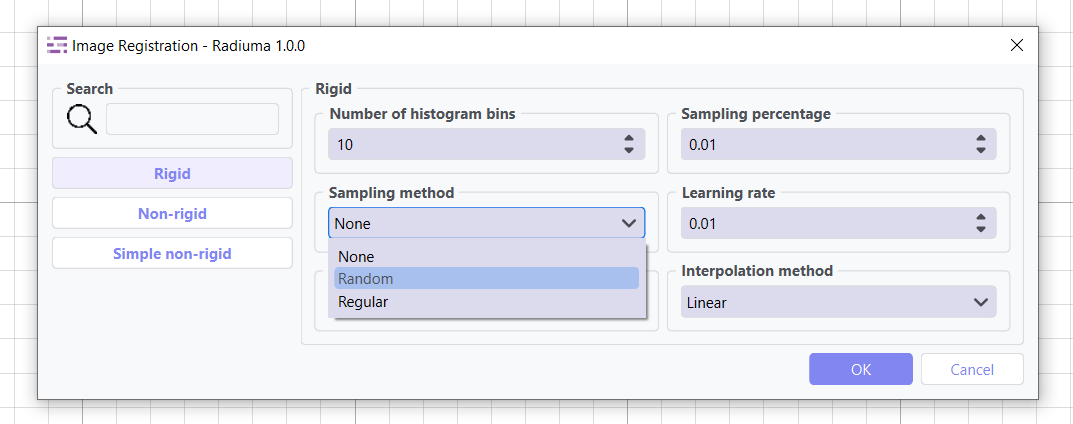
Sampling Percentage: Percentage of voxels to sample (default: 0.01)
Learning Rate: Step size for optimization (default: 0.01)
Number of Iterations: Maximum iterations for optimization (default: 5)
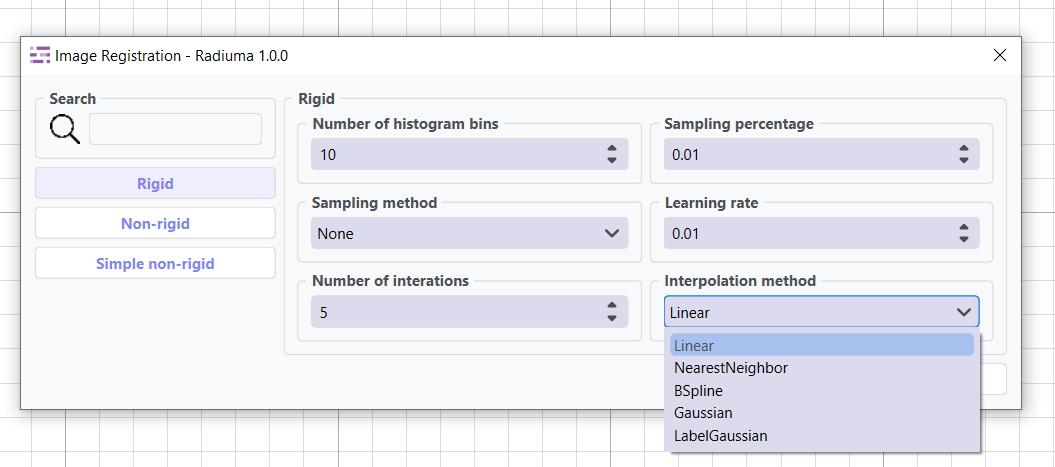
Interpolation: Method for interpolation (Linear, NearestNeighbor, BSpline, Gaussian , LableGaussian.)
Non-Rigid Registration
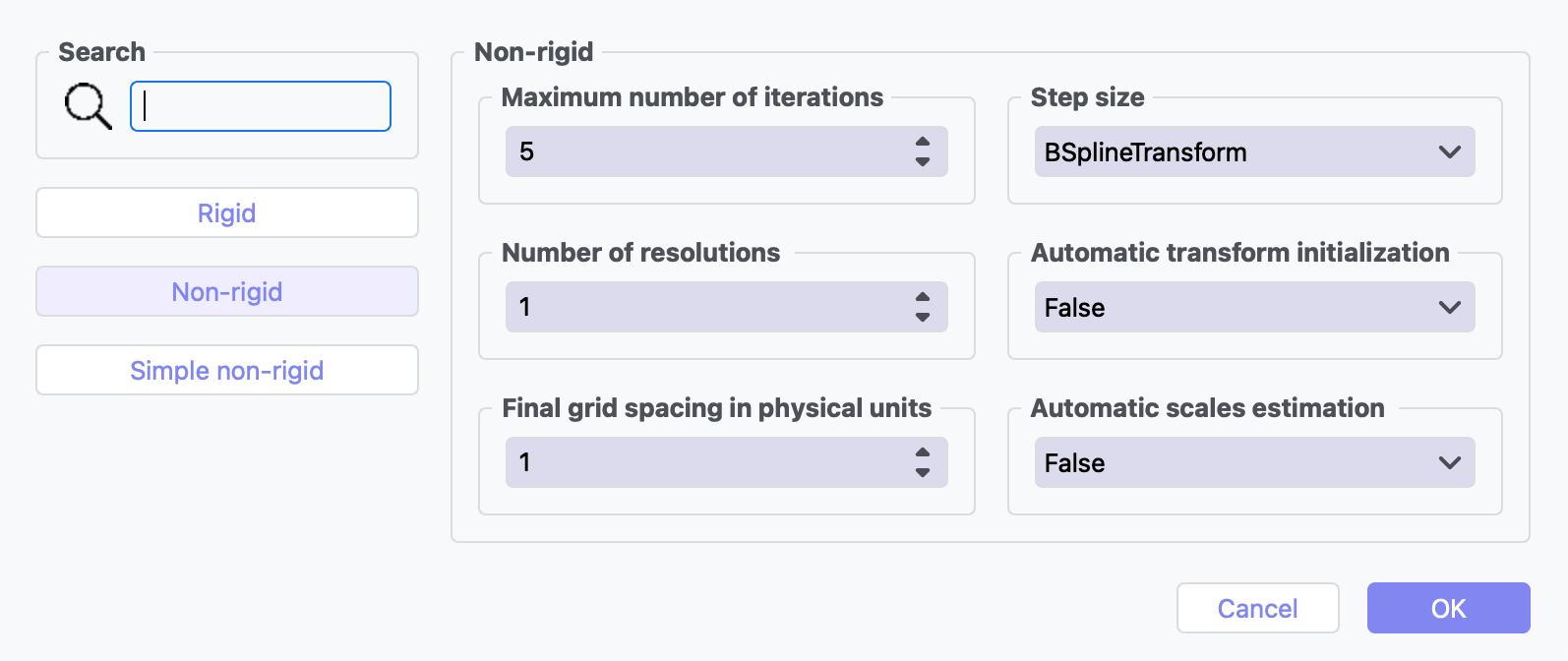
Non-Rigid Registration allows local deformations for more precise alignment, especially useful for soft tissue registration in follow-up or multimodal scans.
Key Parameters
Number of Iterations: Iterations for deformable registration (default: 5)
Number of Resolutions: Multi-resolution levels for optimization (default: 1)
Final Grid Spacing: Density of deformation field (default: 1)
- Transform Type: Type of transformation applied during registration:
BSplineTransform (default)
EulerTransform
AffineTransform
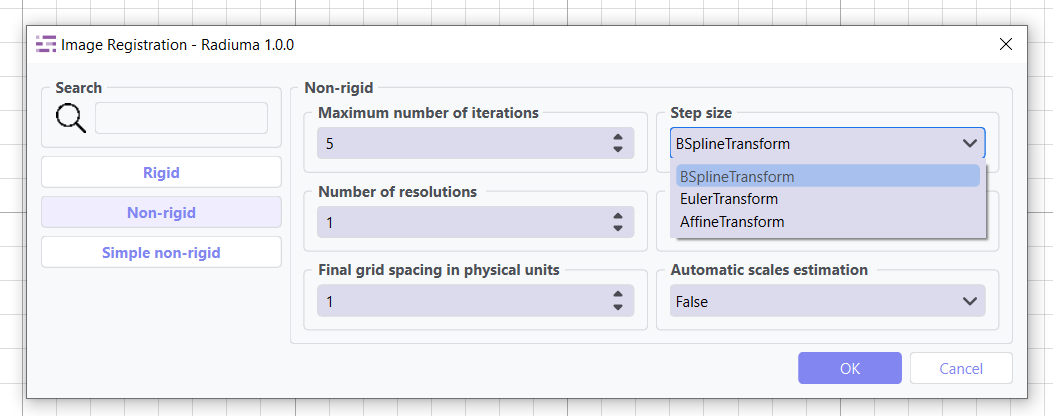
Auto-Transform: Automatic adjustment of transform parameters (True/False)
Auto-Scale: Automatic scaling during registration (True/False)
Simple Non-Rigid Registration

Simple Non-Rigid Registration is a lightweight version of non-rigid registration optimized for speed and simplicity. Good for applications requiring fast processing with moderate accuracy.
Key Parameters
Enable Simple Registration: Toggle simplified non-rigid registration (True/False)
Workflow Integration
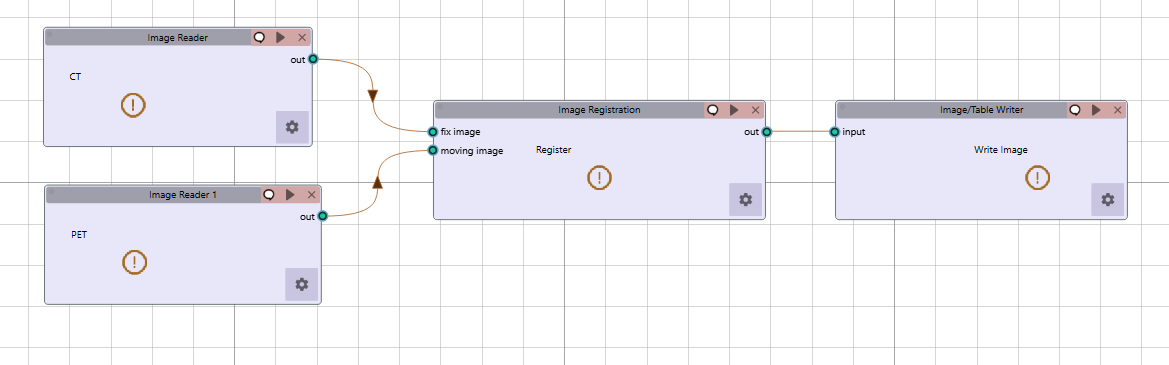
Takes fixed and moving images as inputs
Applies selected registration technique
Outputs transformed image aligned to reference
References
Rigid Registration: Besl, P.J. and McKay, N.D. (1992). “A Method for Registration of 3-D Shapes.” IEEE Transactions on Pattern Analysis and Machine Intelligence, 14(2), 239-256.
Non-Rigid Registration: Rueckert, D., Sonoda, L.I., Hayes, C., Hill, D.L.G., Leach, M.O., and Hawkes, D.J. (1999). “Nonrigid Registration Using Free-Form Deformations: Application to Breast MR Images.” IEEE Transactions on Medical Imaging, 18(8), 712-721.
Simple Non-Rigid: Thirion, J.P. (1998). “Image Matching as a Diffusion Process: An Analogy with Maxwell’s Demons.” Medical Image Analysis, 2(3), 243-260.